Series Summary
This is Part 4 of the Fortress Hemisphere series – an examination of how energy, trade, and security architecture are converging to reshape the Western Hemisphere.
- Part 1: Follow the Pipes – The Guyana oil boom and hemispheric energy strategy
- Part 2: The Squeeze – How Chinese capital is being removed from every chokepoint
- Part 3: The Factory Next Door – How $840 billion in annual trade is binding Mexico into America’s industrial architecture
- Part 4: The Trillion-Dollar Tell (this post) – The automation bet, the labor gap, and a $650 billion wager on what comes next
- Part 5: The Roof – Icebreakers, Arctic trade routes, and the top of the architecture
Key Takeaways
- The US faces a structural blue-collar labor deficit measured in millions – construction needs 349,000 net new workers in 2026, manufacturing has 415,000 unfilled positions, and 42% of crop farmworkers lack work authorization
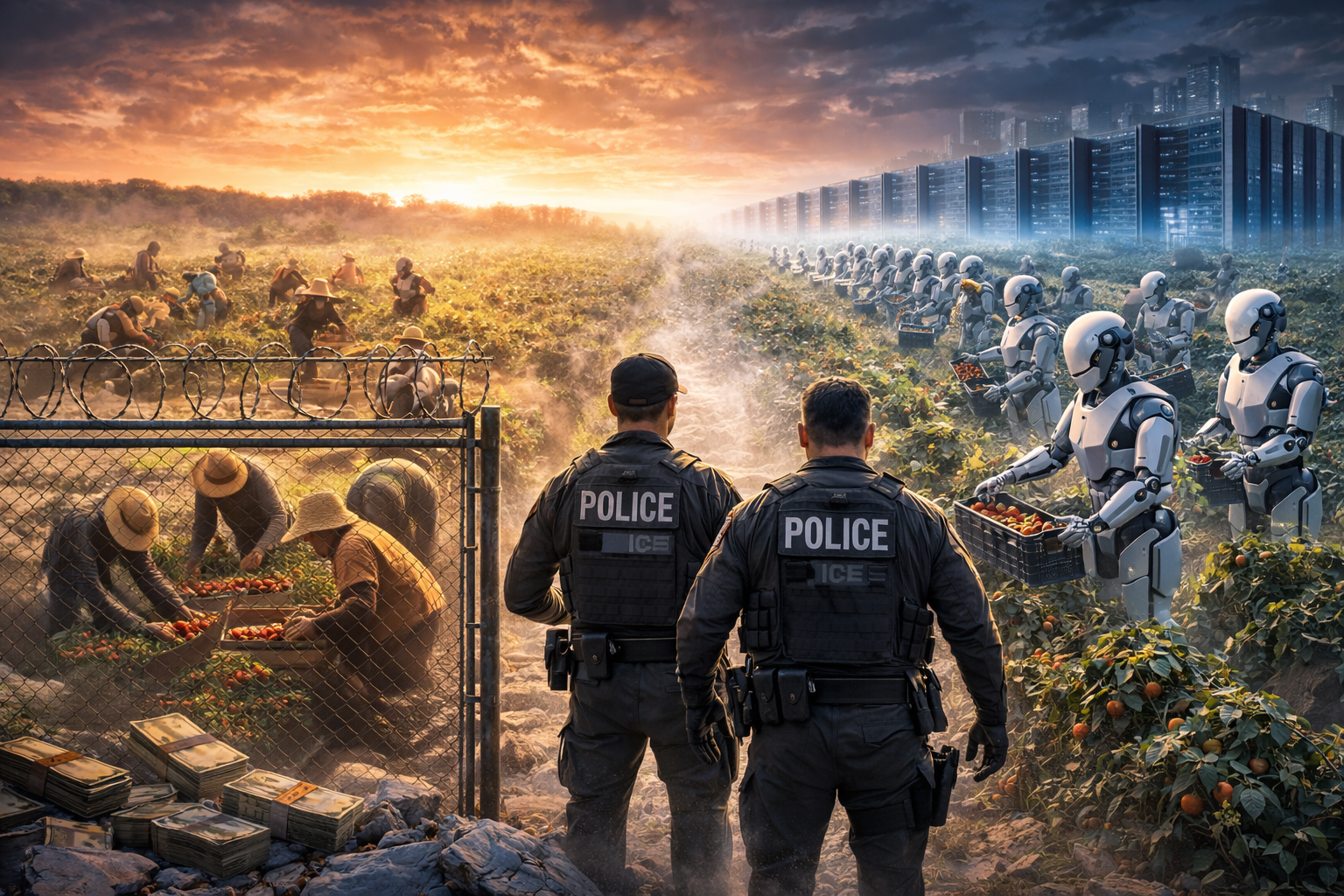
- The Vance Doctrine treats immigration enforcement as industrial policy – deliberately removing cheap labor to force capital investment in automation and robotics
- Five tech companies will spend $635-665 billion on AI infrastructure in 2026 – a 67-74% increase over 2025, with roughly 75% going directly to AI, exceeding the GDP of Sweden
- The “Valley of Death” is the timeline gap between removing human workers now and deploying the AI and robots supposed to replace them – a bet the entire architecture depends on
- The AI infrastructure buildout competes for the same scarce labor it’s meant to replace – data center construction is pulling electricians, welders, and HVAC technicians away from residential and commercial projects
A caveat before we start. Everything in the previous three posts – the energy play in Guyana, the squeeze on Chinese infrastructure, the factory being built in Mexico – is grounded in things that have already happened. Public data. Signed contracts. Tariff schedules. Ships in the water.
This post is different. The argument I’m going to make here depends on technology that does not yet exist. Specifically, it depends on the assumption that embodied AI – artificial intelligence systems that can operate in the physical world through robots and autonomous machines – reaches some baseline level of capability within the next five to ten years. If that assumption is wrong, a large part of the strategic logic I’ve been tracing falls apart, or at least stalls at a stage that looks very different from where its architects seem to think it’s going.
I want to be upfront about that because I think intellectual honesty requires it. A future post will go deep on the technical pathway – what embodied AI actually needs to do, where the robotics are, and what’s real versus vaporware. This post stays on the economic and political side. It asks a simpler question: why is the US government simultaneously building a hemispheric manufacturing architecture that depends on cheap human labor while pursuing a domestic policy designed to eliminate cheap human labor? And why are the largest corporations in history spending more money than the GDP of Sweden on infrastructure that only makes economic sense if something transformational is about to arrive?
The gap
On September 4, 2025, federal agents swarmed an under-construction electric vehicle battery plant in Ellabell, Georgia. The plant was a joint venture between Hyundai and LG Energy Solution – a multibillion-dollar facility that the administration had publicly celebrated as a symbol of the manufacturing renaissance. Agents detained 475 workers, mostly South Korean engineers and technicians brought in by subcontractors to install and calibrate equipment that American workers didn’t yet know how to operate.
It was, according to Homeland Security Investigations, the “largest single-site enforcement operation in the history of homeland security investigations.”
The workers were shackled – wrists, ankles, chest. Their phones were confiscated. South Korea’s president announced he would send a charter plane to bring them home. Hyundai’s CEO said the plant opening would be delayed by months. Thousands of Korean workers across the US left voluntarily in the raid’s aftermath. South Korea’s government expressed “concern and regret.” The CEO of the American Chamber of Commerce in Korea said investment confidence collapsed.
Then Trump said something revealing. Asked about the raid, he told reporters: “If you don’t have people in this country right now that know about batteries, maybe we should help them along.” He said the US needed foreign experts to train Americans in advanced manufacturing – batteries, shipbuilding, computer manufacturing. On Truth Social, he urged companies to bring in skilled workers legally.
The White House later called Hyundai’s CEO to apologize. Georgia’s governor called too, saying, “I don’t know what happened. This is not state jurisdiction.”
ICE raids the factory the administration is trying to build. The president simultaneously defends the raid and admits the country doesn’t have the workers to replace the ones who got arrested. That contradiction is the center of this entire architecture.
That episode captures the tension at the heart of the current moment. The United States is pursuing two policies that are in direct tension. It’s building a hemispheric manufacturing base that requires human labor. And it’s removing the human labor.
The numbers underneath
The blue-collar labor gap in the United States is not a projection. It’s a documented, measured, sector-by-sector reality that predates the current administration and is being sharply accelerated by its immigration enforcement.
Start with construction. The Associated Builders and Contractors estimated that the industry needed 349,000 net new workers in 2026 just to keep up with current demand – down from 439,000 in 2025 and over 500,000 in each of the two years before that. The number dropped not because the shortage improved but because demand cooled. ABC’s chief economist, Anirban Basu, was blunt: “Nothing changed in the model. What changed is the cycle.” The structural drivers – retirements, demographics, skills mismatches – are all still in place. When demand rebounds in 2027, ABC projects the gap will widen again to 456,000.
The Associated General Contractors of America surveyed nearly 1,400 firms in 2025. Ninety-two percent of firms that were hiring reported difficulty finding qualified workers. Forty-five percent said labor shortages were the leading cause of project delays. Immigration enforcement had already impacted nearly one-third of construction firms.
The Home Builders Institute put a dollar figure on it. The skilled labor shortage in residential construction costs the economy $10.8 billion per year – $2.7 billion in carrying costs and $8.1 billion in lost home construction. That translates to roughly 19,000 homes per year that don’t get built. Immigrants now account for 25.5% of the construction workforce, a historic high. In the construction trades specifically, one in three craftsmen is foreign-born.
Only 7% of potential job seekers say they’d consider a career in construction. And 53% of the current construction workforce is expected to retire in the next decade.
Now look at manufacturing. The Bureau of Labor Statistics’ JOLTS data showed 415,000 unfilled manufacturing positions as of December 2025 – and that’s in a flat market. The Deloitte-Manufacturing Institute study – the most comprehensive workforce analysis the sector has – projected that 3.8 million manufacturing workers will be needed between 2024 and 2033. Half of those, 1.9 million, are expected to go unfilled. The demand is driven overwhelmingly by retirements: 2.8 million of the 3.8 million slots are replacement demand as experienced workers leave.
Only 14% of Gen Z say they’d consider a career in manufacturing. Average manufacturing wages sit around $25 per hour – below the national average.
Agriculture is worse. The USDA’s National Agricultural Workers Survey found that 42% of crop farmworkers had no work authorization as of 2020-22. The Center for Migration Studies estimates that 86% of agricultural workers are foreign-born, with approximately 50% undocumented. The farm workforce is aging – the average age of foreign-born farmworkers rose seven years between 2006 and 2022 – and fewer young immigrants are entering the pipeline. The American Immigration Council documented that California’s agricultural workforce is over 80% immigrant.
The H-2A visa program, the only legal channel for temporary agricultural labor, has more than tripled from 79,000 workers in 2010 to over 258,000 by 2019. It still can’t fill the gap. Farmers describe the application process as expensive and cumbersome. And the fresh produce that can’t get harvested domestically is increasingly imported – the share of raspberries consumed in the US that were imported more than doubled between 2000 and 2019, from 35% to 70%.
Across construction, manufacturing, and agriculture, the US economy has a structural deficit of human workers measured in the millions, concentrated in exactly the sectors that the hemispheric architecture is supposed to revitalize.
These aren’t marginal shortages. The factories being nearshored from China, the data centers being built for AI, the infrastructure projects funded by the IRA and CHIPS Act – all of them need workers that the country does not have in sufficient numbers.
The doctrine
Into this labor gap, the administration walked with a deliberate policy choice.
On March 18, 2025, Vice President JD Vance delivered a speech at the American Dynamism Summit – a gathering of venture capitalists and tech CEOs hosted by Andreessen Horowitz in Washington. The speech laid out what I’d call the Vance Doctrine, though he didn’t use that phrase. He said it plainly enough.
“Cheap labor is fundamentally a crutch, and it’s a crutch that inhibits innovation. I might even say that it’s a drug that too many American firms got addicted to.”
He went further: “For far too long, we got addicted to cheap labor, both overseas and by importing it into our own country – and we got lazy. We overregulated our industries instead of supporting them, we overtaxed our innovators instead of making it easier for them to build their great companies, and we made it way too hard to build things and invest in things in the United States of America.”
This is not accidental rhetoric. It’s a framework. Vance’s argument is that as long as cheap labor exists – whether through immigration or offshoring – capital will never invest in automation. The low-cost worker is a substitute for the robot. Remove the worker, and the robot becomes the only option. Force the investment.
“When you erect a tariff wall around a critical industry like auto manufacturing and you combine that with advanced robotics and lower energy costs and other tools that increase the productivity of US labor, you give American workers a multiplying effect,” Vance told the audience.
Trump echoed it in his own way. “We’re going to need robots… to make our economy run because we do not have enough people,” he told Breitbart News in August 2025.
Now look at what followed Vance’s speech. In June 2025, the administration dramatically escalated workplace enforcement. ICE raids expanded across Los Angeles, Tallahassee, New Orleans, San Diego, Martha’s Vineyard, and the Berkshires. DHS reported daily arrest numbers rising from 600 to over 2,000. White House border czar Tom Homan stated: “You’re going to see more work site enforcement than you’ve ever seen in the history of this nation.” The One Big Beautiful Bill, signed July 4, gave ICE what its director called “unprecedented funding.”
The American Immigration Council documented the impact. Agricultural employment dropped by 155,000 workers between March and July 2025, compared to a 2.2% increase in the same period the prior year. The 10 states with the highest concentration of undocumented construction workers saw a 0.1% drop in construction employment while other states saw a 1.9% increase. Goldman Sachs estimated that 15-20% of workers in construction-related industries may be undocumented.
A June 12 ICE email – reported by the New York Times – instructed regional offices to “hold all work site enforcement investigations/operations on agriculture, restaurants, and operating hotels.” Agents were told not to arrest “noncriminal collaterals.” Then, according to the Washington Post, the order was reversed. Agents were told to continue conducting raids at agricultural businesses, hotels, and restaurants regardless.
The policy is doing what Vance said it would. It’s raising the risk premium of human labor. It’s making cheap workers scarce and expensive. And it’s being done consciously, with stated intent, as an industrial policy mechanism – not just an immigration enforcement action.
The question is what’s supposed to fill the hole.
The tell
Here’s where the money comes in.
In the first weeks of 2026, four companies – Amazon, Alphabet, Meta, and Microsoft – reported their capital expenditure plans for the year. The numbers were staggering.
Amazon: $200 billion. Alphabet: $175-185 billion. Meta: $115-135 billion. Microsoft: on pace for $140+ billion based on first-half spending of $72 billion. Combined, the four hyperscalers are projected to spend roughly $635-665 billion in 2026. Add Oracle at $50 billion and the total approaches $700 billion.
That’s a 67-74% increase over 2025, which was itself a record year at $381 billion combined. The vast majority – CreditSights estimates roughly 75%, or about $450 billion – is going directly to AI infrastructure: GPUs, data centers, custom chips, networking, and power.
The combined 2026 capex of these five companies exceeds the GDP of Sweden. It exceeds the GDP of Poland. Goldman Sachs noted that Wall Street has consistently underestimated these numbers – the consensus forecast for 2026 called for a 19% increase; the actual increase will be closer to 70%.
Every hyperscaler reported that they are supply-constrained, not demand-constrained. Microsoft disclosed an $80 billion backlog of Azure AI orders that it cannot fulfill due to power constraints. Alphabet’s cloud backlog surged 55% sequentially to over $240 billion. Amazon’s CEO said: “Customers really want AWS for core and AI workloads. We’re monetizing capacity as fast as we can install it.”
These companies are not spending $650 billion on incremental improvements to existing products. They are building infrastructure for something that doesn’t fully exist yet. The tell is in the scale. You don’t pour money at that rate – driving free cash flow negative, issuing tens of billions in new debt, accepting 90% drops in free cash flow – for marginal gains. You spend like this when you believe something transformational is imminent. When the capability curve is about to inflect.
Meta’s CFO, asked about capital allocation, said the “highest order priority is investing our resources to position ourselves as a leader in AI.” Microsoft’s CEO said the company will “increase AI capacity by over 80% this year and roughly double our total data center footprint over the next two years.” These are not hedged statements.
BCA Research noted that the five hyperscalers plan to add roughly $2 trillion of AI-related assets to their balance sheets by 2030. At a 20% annual depreciation rate, that implies $400 billion per year in depreciation expense – more than their combined profits in 2025. And this doesn’t include OpenAI’s $1.4 trillion in announced data center ambitions, or the billions from Anthropic, xAI, and the emerging “neoclouds” like CoreWeave and Lambda.
This is the largest single-purpose capital deployment in the history of corporate enterprise. And the question you have to ask is: what do they think is coming?
The valley of death
Somewhere between the immigration enforcement and the AI infrastructure spending, there’s a gap. The workers are being removed now. The technology that’s supposed to replace them doesn’t work yet – at least not at the scale and in the environments where it’s needed.
This is the “Valley of Death.” The administration’s implicit bet is that AI and robotics will advance fast enough to fill the labor gap before the economic damage becomes politically fatal. If the humans leave before the robots arrive, the US faces supply shocks in exactly the sectors that matter most to ordinary people.
Vance himself has acknowledged the timeline risk. Go back to the data. Construction needs 349,000 workers this year and can’t find them. Fifty-three percent of the workforce retires within a decade. Agricultural employment dropped 155,000 workers in five months because of enforcement actions. Manufacturing has 415,000 unfilled positions in a flat market and faces 1.9 million unfilled slots by 2033.
Now ask: where are the robots?
There are construction robots that can lay bricks. There are agricultural drones that can spray fields. There are warehouse robots that can move pallets. But there is no general-purpose embodied AI system that can frame a house, pick strawberries, wire an electrical panel, operate a combine in variable terrain, or do the thousand improvised physical tasks that a $15-an-hour human worker does on a construction site or a farm every day.
That’s the gap this entire architecture is built over. The hemispheric factory depends on cheap human labor – in Mexico at $4.90 an hour, in Guatemala at less. The domestic economy depends on immigrant labor for construction, agriculture, and food processing. The administration is simultaneously tightening the labor supply and betting that technology will fill the void.
If the bet pays off – if embodied AI reaches baseline capability within the next five to seven years – then the logic clicks. The tariff wall forces investment in automation. Automation raises productivity. Higher productivity justifies higher wages for the remaining human workers. The hemispheric manufacturing base transitions from cheap-labor-dependent to technology-augmented. Mexico becomes the mid-stage factory that eventually upgrades, and the US becomes the high-tech production hub that the Vance Doctrine envisions.
If the bet doesn’t pay off – if the robots take ten years instead of five, or if the hard problems in physical manipulation and unstructured environments turn out to be as intractable as some roboticists believe – then you get the stagflation trap. Construction freezes. Housing starts crater. Agricultural prices spike. Strawberries hit $15 a pack. And the political backlash in 2028 tears apart the coalition that built the architecture.
The timeline is everything. And nobody – not Vance, not the hyperscaler CEOs, not the robotics companies – can tell you with confidence which timeline we’re on.
The connection
I’ve spent a lot of time in the previous posts being careful to note that you don’t need a conspiracy to produce the patterns I’m describing. Convergent evolution – multiple rational actors pursuing aligned interests – explains most of what I’ve shown you.
But the capex wave introduces something harder to explain away. The $650 billion in 2026 AI infrastructure spending is not convergent evolution. It’s a coordinated sprint. These companies are watching each other’s earnings calls, matching each other’s numbers, and explicitly stating that falling behind would be strategically fatal. Goldman Sachs noted that every year since 2024, the consensus estimate for hyperscaler capex has been dramatically wrong in the same direction – too low, by a factor of three to four. The companies are spending faster than the analysts can model.
And the spending is connected to the labor story in a way that’s hard to ignore. The same data centers being built with $650 billion in capital need construction workers to build them – ABC specifically noted that data center and power facility projects are pulling skilled trades workers away from residential and commercial construction, exacerbating shortages everywhere else. The AI infrastructure buildout is competing for the same scarce labor it’s ultimately supposed to replace.
The Deloitte Insights analysis put it directly: “The growth in construction jobs fostered by policy incentives may intensify competition for welders, electricians, and other trades, which could exacerbate the imbalance in labor supply and demand in manufacturing.” The system is eating itself in the transition.
Trump seemed to grasp this after the Hyundai raid. “We do have to work something out where we bring in experts so that our people can be trained so that they can do it themselves,” he said. That’s the admission. The factory needs workers the country doesn’t have. The administration’s own immigration policy is making the shortage worse. And the technology that’s supposed to solve it isn’t ready.
The picture
Step back one more time.
Over the course of this series, I’ve traced a pattern through energy, infrastructure, trade, and now labor and technology. In Guyana, the US built an energy supply chain secured by its military and operated by its companies. In Panama, Costa Rica, and across the hemisphere, Chinese presence at strategic chokepoints is being systematically removed. In Mexico, a managed trade agreement is binding $840 billion in annual commerce into a shared manufacturing system with a tariff wall around it.
And now, inside the United States, the administration is pursuing a domestic industrial policy that treats immigration enforcement as an economic lever – consciously removing cheap labor to force capital investment in automation, betting that AI and robotics will mature fast enough to fill the resulting gap.
Each of these can be explained independently. Exxon drills in Guyana because it’s profitable. Panama seizes ports because its Supreme Court said the contracts were unconstitutional. Mexico imposes tariffs on China because it wants to secure its position in the USMCA review. Companies spend on AI because they’re competing with each other and demand is outpacing supply.
But when you lay them together – energy, infrastructure, manufacturing, and now automation – they form something that looks like a sequence.
Secure the energy. Control the chokepoints. Build the factory. Then build the machine that replaces the factory.
Whether that sequence is intentional or emergent, I genuinely can’t tell you. What I can tell you is that $650 billion doesn’t get spent on a guess. The people writing those checks believe something is coming. The administration that’s emptying the construction sites and the farms believes something is coming. And the gap between “something is coming” and “something is here” is where the whole architecture is most vulnerable.
A future post will go deep on the technical side – what embodied AI actually requires, where the major robotics programs stand, what’s achievable in five years versus what’s science fiction. That post will try to answer the question this one raises: is the bet reasonable?
For now, the bet is placed. The money is moving. And the clock is running.
Next: The Roof – How a 48-year-old icebreaker, a $6 billion deal with Finland, and an island of 56,000 people explain the top of the architecture.
Sources and data referenced in this post:
- Fox News, “Trump backs ICE raid at Hyundai plant, but says US needs foreign experts to train Americans,” September 8, 2025 – 475 arrests, Trump quotes on needing experts, South Korea charter plane (foxnews.com)
- ABC News, “These South Korean workers came to the US to build an EV battery plant. They left in shackles,” November 11, 2025 – “largest single-site enforcement operation in HSI history,” workers shackled, Trump October comments, Hyundai CEO delay announcement, AmCham Korea quotes (abcnews.com)
- Carscoops, “Hyundai CEO Says White House Apologized After Trump Opposed ICE Raid,” November 21, 2025 – White House apology call, Georgia governor quote (carscoops.com)
- Axios, “Trump says foreign experts welcome after fallout from Hyundai raid,” September 14, 2025 – timeline and context of administration response (axios.com)
- Associated Builders and Contractors, January 2026 – 349,000 net new workers needed in 2026, 439,000 in 2025, 456,000 projected for 2027 (abc.org)
- Engineering News-Record, “Construction’s Labor ‘Relief’ Masks Structural Risk,” January 15, 2026 – Anirban Basu quote: “Nothing changed in the model. What changed is the cycle.” (enr.com)
- Associated General Contractors of America / NCCER, 2025 Workforce Survey, August 2025 – 92% of firms report difficulty finding workers, 45% cite shortages as leading cause of delays, nearly 1/3 impacted by immigration enforcement (agc.org)
- Home Builders Institute / NAHB, Fall 2025 Construction Labor Market Report – $10.8B annual economic impact of shortage, 19,000 homes not built, immigrants at 25.5% of construction workforce (historic high), 1 in 3 craftsmen foreign-born, 53% of workforce expected to retire within decade (nahb.org)
- Amtec US, “Construction Workforce Data & Benchmarks 2025-2026” – 7% of job seekers consider construction, $40.55/hour average earnings, 45% of firms report delays from shortages (amtec.us.com)
- St. Louis Federal Reserve / FRED, JOLTS Manufacturing Job Openings – 433,000 in December 2025 (preliminary), 415,000 range through Q4 (fred.stlouisfed.org)
- Deloitte and the Manufacturing Institute, “Taking charge: Manufacturers support growth with active workforce strategies,” April 2024 – 3.8 million workers needed by 2033, 1.9 million projected unfilled, 2.8 million from retirements (deloitte.com / themanufacturinginstitute.org)
- Fortune, “Nearly 4 million new manufacturing jobs coming to America as boomers retire – but it’s the one trade job Gen Z doesn’t want,” December 4, 2025 – 14% of Gen Z would consider manufacturing, average wage approximately $25/hour (fortune.com)
- USDA Economic Research Service / National Agricultural Workers Survey (NAWS) 2020-22 – 42% of crop farmworkers had no work authorization, 32% US-born, average age of foreign-born farmworkers rose approximately 7 years since 2006 (ers.usda.gov / dol.gov)
- Center for Migration Studies – 86% of agricultural workers foreign-born, approximately 50% undocumented, 88% from Mexico (cmsny.org)
- American Immigration Council, “Immigration and Agriculture,” August 2025 – California ag workforce 80%+ immigrant, raspberry import share doubled from 35% to 70% (2000-2019), H-2A program growth from 79,000 (2010) to 258,000 (2019) (americanimmigrationcouncil.org)
- JD Vance, American Dynamism Summit keynote (Andreessen Horowitz), March 18, 2025 – Full transcript: “Cheap labor is fundamentally a crutch,” tariff wall + robotics quote (rev.com / foxnews.com / dailysignal.com / techcrunch.com)
- Breitbart News, November 2025 – Trump: “We’re going to need robots… to make our economy run because we do not have enough people” (breitbart.com)
- American Immigration Council, “Trump’s Immigration Actions Are Taking a Toll on Local Economies,” August 28, 2025 – agricultural employment dropped 155,000 workers (March-July 2025), construction employment 0.1% drop in high-undocumented states vs. 1.9% gain elsewhere (americanimmigrationcouncil.org)
- Goldman Sachs – 15-20% of construction-related workforce may be undocumented (cited via CNN, CFMA)
- CNN Business, “ICE workplace raids are taking a toll on America’s businesses and workers,” June 14, 2025 – Goldman Sachs estimates (cnn.com)
- Immigration Policy Tracking Project – NYT reporting on June 12, 2025 ICE email pausing agriculture/restaurant raids, subsequent WaPo reporting on reversal, DHS daily arrests rising from 600 to 2,000, Tom Homan quote (immpolicytracking.org)
- Construction Dive, “ICE raids leave future of construction labor in limbo,” February 13, 2026 – One Big Beautiful Bill funding, ICE Director Todd Lyons “unprecedented funding” quote (constructiondive.com)
- Yahoo Finance, “Big Tech set to spend $650 billion in 2026,” February 6, 2026 – Amazon $200B, Alphabet $175-185B, Meta $115-135B, Microsoft approximately $140B+, combined $635-665B, 67-74% increase over 2025 (finance.yahoo.com)
- CNBC, “Tech AI spending approaches $700 billion in 2026, cash taking big hit,” February 6, 2026 – free cash flow drops up to 90%, Amazon potentially FCF-negative, Meta CFO “highest order priority” quote, Microsoft CEO “double data center footprint” quote (cnbc.com)
- Fortune, “Big Tech’s $630 billion AI spree now rivals Sweden’s economy,” February 6, 2026 – comparable to national GDPs (fortune.com)
- Futurum Group, “AI Capex 2026: The $690B Infrastructure Sprint,” February 2026 – $660-690B including Oracle, Microsoft $80B unfulfilled Azure backlog, Alphabet $240B cloud backlog (futurumgroup.com)
- CreditSights, “Hyperscaler Capex 2026 Estimates” – approximately 75% of capex (approximately $450B) directly AI infrastructure (creditsights.com)
- Goldman Sachs – consensus estimate for hyperscaler capex consistently too low: forecast 19% growth for 2024, actual was 54%; forecast 22% for 2025, actual was 64%; forecast 19% for 2026, actual tracking approximately 70% (cited via Motley Fool)
- BCA Research – hyperscalers planning $2 trillion in AI-related balance sheet assets by 2030, $400B/year depreciation implied, exceeding combined profits (cited via IEEE ComSoc)
- Deloitte Insights, “US Manufacturing Labor Impact,” January 2026 – construction job competition for welders/electricians exacerbating manufacturing shortage (deloitte.com)
This is Part 4 of the Fortress Hemisphere series. Part 1: Follow the Pipes covers the Guyana energy story. Part 2: The Squeeze covers the systematic removal of Chinese infrastructure from the hemisphere. Part 3: The Factory Next Door covers Mexico’s role as the hemispheric manufacturing hub. Part 5: The Roof covers the Arctic, icebreakers, and the top of the architecture.