Series Summary
This is Part 2 of the Fortress Hemisphere series – an examination of how energy, trade, and security architecture are converging to reshape the Western Hemisphere.
- Part 1: Follow the Pipes – The Guyana oil boom and hemispheric energy strategy
- Part 2: The Squeeze (this post) – How Chinese capital is being removed from every chokepoint
- Part 3: The Factory Next Door – How $840 billion in annual trade is binding Mexico into America’s industrial architecture
- Part 4: The Trillion-Dollar Tell – The automation bet, the labor gap, and a $650 billion wager on what comes next
- Part 5: The Roof – Icebreakers, Arctic trade routes, and the top of the architecture
Key Takeaways
- Panama physically seized its canal ports from CK Hutchison on February 23, 2026, handing them to Maersk and MSC after a Supreme Court ruling voided the Chinese-linked concession
- USMCA Article 32.10 acts as a structural “poison pill” – any member that signs a free trade agreement with China risks expulsion from the North American trade bloc
- Canada tested the fence with a limited China EV/canola deal, drew 100% tariff threats from Trump, and backed off from broader engagement – while quietly increasing its US Treasury holdings
- Mexico imposed tariffs up to 50% on Chinese goods ahead of the USMCA review, demonstrating compliance before being asked
- Costa Rica banned Huawei from 5G, prosecuted its officials for corruption, and was rewarded with US cybersecurity investment and semiconductor supply chain positioning
In the first post in this series, I laid out how the United States has quietly built an energy architecture in Guyana – the fastest-growing oil basin on earth, operated by ExxonMobil, secured by the US Navy, pumping 900,000 barrels a day and heading toward 1.7 million by 2030.
I ended that post with a loose thread. Twenty-five percent of the Stabroek Block – the crown jewel of this entire operation – is owned by CNOOC, a subsidiary of the China National Offshore Oil Corporation. A Chinese state-backed company holds a quarter of the most strategically significant new energy asset in the Western Hemisphere, sitting inside an American security perimeter.
That’s an awkward arrangement. And it’s not the only one.
Across the hemisphere, Chinese companies have spent the last two decades buying into ports, mines, telecom networks, and energy concessions. For most of that time, nobody in Washington paid much attention. Now they are. And what’s happening – across multiple countries, through different mechanisms, but with unmistakable coherence – is a systematic squeeze.
The Chinese presence in the Western Hemisphere is being identified, pressured, and removed. Not through a single executive order or dramatic confrontation, but through contracts, court rulings, trade clauses, and tariff schedules. The tools are bureaucratic. The effect is strategic.
The Canal
Start with Panama, because what happened there this week tells you everything.
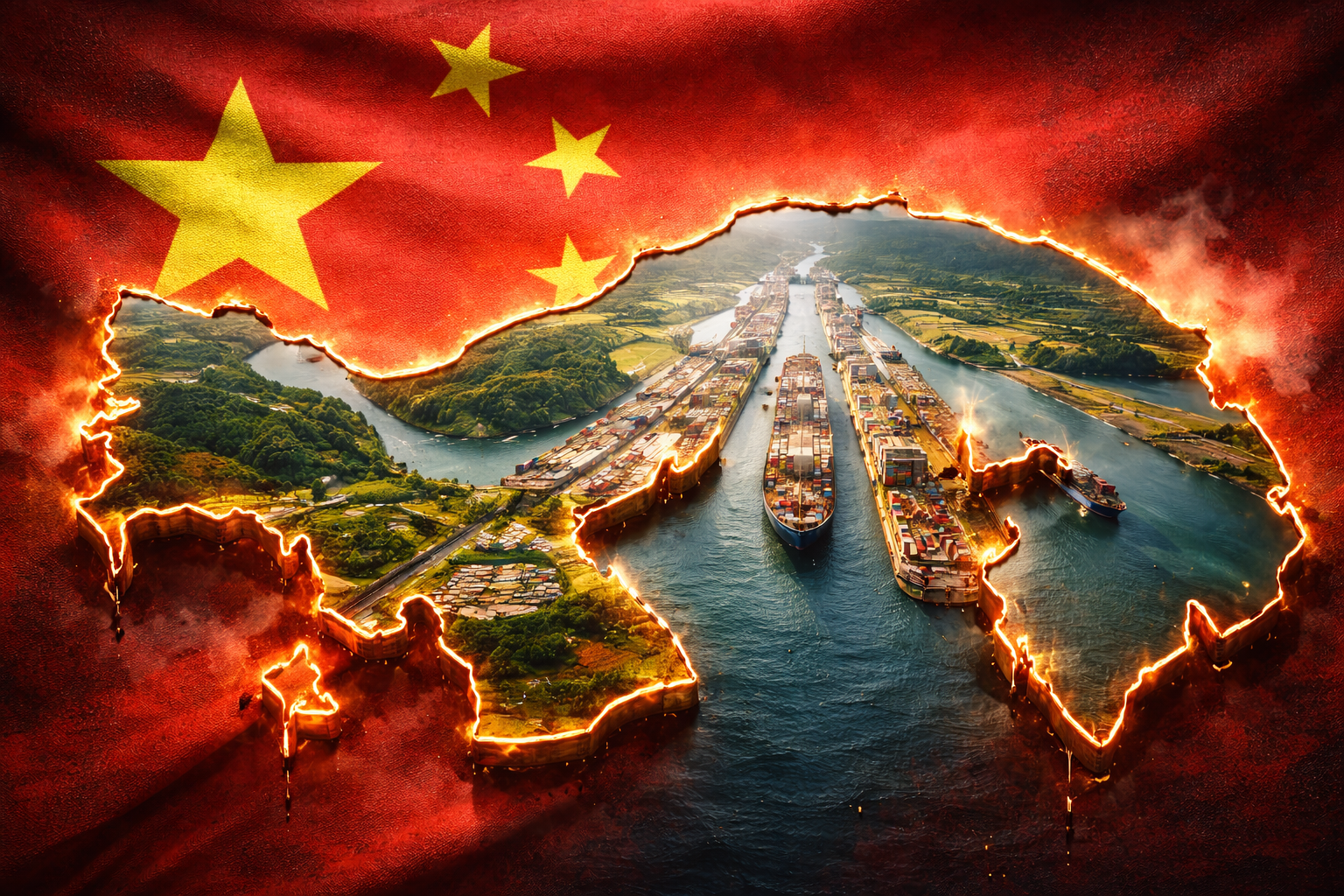
On February 23, 2026 – literally yesterday as I write this – the Panamanian government physically seized control of the ports of Balboa and Cristobal from CK Hutchison Holdings, the Hong Kong-based conglomerate that had operated them since 1997. Workers were told to leave. CK Hutchison says its employees were threatened with criminal prosecution if they didn’t comply. The company called it “unlawful” and filed for international arbitration.
The backstory is worth walking through, because it shows how these things actually work.
CK Hutchison operated ports at both ends of the Panama Canal – Balboa on the Pacific side, Cristobal on the Atlantic. The canal handles roughly 5% of global maritime trade and about 40% of US container traffic. When Donald Trump returned to office in January 2025, he began publicly claiming that “China is operating the Panama Canal” and threatened to “take it back,” including by military force if necessary.
CK Hutchison is technically a Hong Kong company, not a mainland Chinese state enterprise. But in Washington, the distinction didn’t matter. Senator Ted Cruz called the port operations “ready observation posts” for China. Secretary of State Marco Rubio flew to Panama in February 2025 and told President Mulino that Panama needed to reduce Chinese influence over the canal or face consequences.
Within weeks, Panama launched an audit of the port contracts. In March 2025, CK Hutchison announced a $22.8 billion deal to sell its port assets – 43 ports in 23 countries, including the two Panama terminals – to a consortium led by BlackRock, Global Infrastructure Partners, and Terminal Investment Limited (a subsidiary of Mediterranean Shipping Company). The deal would place the canal ports under American financial control.
Then Beijing intervened. China demanded the sale undergo its own regulatory review, even though no mainland Chinese assets were involved. By summer, Chinese state-owned shipping giant COSCO had been invited into the deal – initially for a 20-30% stake in the non-Panama ports. COSCO then demanded a majority stake. BlackRock and MSC considered walking away entirely. The deal stalled.
Panama’s Supreme Court didn’t wait. In January 2026, the court ruled CK Hutchison’s concession unconstitutional – despite the company having renewed that concession for another 25 years just back in 2021. On February 23, the government published the ruling in the official gazette, formally voiding the contracts, and physically occupied the terminals. Maersk’s APM Terminals took over Balboa; MSC’s Terminal Investment Limited took Cristobal. An 18-month transition period begins, after which new concessions will be awarded through international tender.
Beijing’s response was swift. Bloomberg reported that China is instructing state firms to halt negotiations on new projects in Panama and asking shipping companies to consider rerouting cargo through other ports. Hong Kong’s government filed a “stern protest.” China’s Hong Kong and Macao Affairs Office warned Panama would “pay a heavy price, both politically and economically.”
The US Ambassador to Panama, Kevin Cabrera, said the Supreme Court ruling was “very good” for the people of Panama.
There’s a revealing comparison buried in all this. Panama’s Supreme Court also ruled a Canadian-owned copper mine unconstitutional – using nearly identical legal reasoning. The government’s response to that ruling? Negotiation. Accommodation. Same court. Same constitutional argument. Two totally different enforcement postures. The variable isn’t the law. It’s who’s standing behind the asset.
The Clause
The Panama story is dramatic, but the more structurally important mechanism is quieter. It’s Article 32.10 of the USMCA – the US-Mexico-Canada trade agreement – and it’s the legal architecture that constrains the entire hemisphere’s relationship with China.
Here’s what it says: If any USMCA member enters into a free trade agreement with a “non-market economy” – a category that includes China – the other two members can terminate the entire agreement with six months’ notice and replace it with a bilateral deal that excludes the offending party.
The clause also requires that any member planning to negotiate an FTA with a non-market economy must notify the other two parties three months in advance and provide the full text of the proposed agreement 30 days before signing.
Academics have debated whether Article 32.10 is a genuine “poison pill” or merely symbolic posturing. The academic arguments are interesting. The practical reality is simpler: Canada sends 75% of its goods exports to the United States. Any Canadian government that signed a comprehensive FTA with China would be gambling the entire economic relationship with its largest trading partner. The clause doesn’t need to be legally airtight. It just needs to make the cost of defection catastrophic.
US Commerce Secretary Wilbur Ross, who helped negotiate the original USMCA, was explicit about the purpose. He called it a measure to “close loopholes” that could legitimize China’s trade practices. Larry Kudlow, then director of the National Economic Council, said USMCA meant North America was now “a united front in dealing with China.”
The Chinese Embassy in Ottawa called it “dishonest behaviour” that “blatantly interferes with the sovereignty of other countries.”
They’re both right. It does interfere with sovereignty. That’s the point.
The Stress Test: Canada
If Article 32.10 is the fence, Canada just tested it.
On January 16, 2026, Prime Minister Mark Carney flew to Beijing – the first Canadian PM visit to China since 2017 – and announced what he called a “landmark” trade deal with President Xi Jinping. Canada agreed to allow 49,000 Chinese-made electric vehicles into the Canadian market at a tariff of 6.1%, down from the 100% tariff imposed under Justin Trudeau in 2024. In exchange, China would slash tariffs on Canadian canola seed from 84% to approximately 15%, and drop tariffs on canola meal, lobsters, crabs, and peas.
Carney described it as a “new partnership, a new era.” He told reporters that China was a “more predictable” partner than the United States. He discussed Greenland with Xi. He said Canada would double its energy grid and produce 50 million tonnes of LNG per year for Asian markets by 2030.
The optics were calculated to be provocative. And they were.
Trump initially shrugged. “That’s what he should be doing. It’s a good thing for him to sign a trade deal. If you can get a deal with China, you should do that,” he told reporters on January 16. Then Carney flew to Davos, gave a speech warning about “coercion by great powers” without naming the United States, and received a standing ovation. Trump’s tone changed. By January 25, he was posting on Truth Social: “If Governor Carney thinks he is going to make Canada a ‘Drop Off Port’ for China to send goods and products into the United States, he is sorely mistaken.” He threatened 100% tariffs on all Canadian exports.
Treasury Secretary Scott Bessent went on ABC and said: “We can’t let Canada become an opening that the Chinese pour their cheap goods into the US. We have a USMCA, but based on that, which is going to be renegotiated this summer, and I’m not sure what Prime Minister Carney is doing here, other than trying to virtue-signal to his globalist friends at Davos.”
Now look at what the deal actually contains.
The 49,000 EVs represent about 3% of annual Canadian vehicle sales. Carney said he expects the quota to rise about 6% per year, reaching 70,000 in five years – still a trivial share of the market. At least half of the imported vehicles must be priced under $35,000. The canola tariff reductions unlock roughly $3 billion in export orders for Canadian farmers, but tariffs on canola oil (100%) and pork (25%) remain fully in place. The deal is explicitly described as a “framework agreement” – a diplomatic term for something that could expand or quietly expire.
Carney himself told reporters he respects Canada’s obligations under USMCA and has no intention of pursuing a comprehensive free trade agreement with China.
Here’s the most revealing data point. While all this diplomatic theater was playing out, Canadian holdings of US Treasury securities were climbing. In December 2024, Canada held $378.8 billion in US Treasuries. By March 2025, that was $426.2 billion – a 12.5% increase in three months. By November 2025, it reached $472.2 billion. Canada was buying US debt at a pace that would have been striking even in calm times. During a trade war with Washington, it’s a signal: whatever the rhetoric, the money is flowing toward the United States, not away from it.
A viral story circulated on Canadian social media claiming Carney had organized a coalition of countries – Japan, the UK, France – to dump US Treasuries and force Trump to back down on tariffs. It was fiction. Every country named in the story actually increased their Treasury holdings during the same period.
So what’s the play? Carney is building leverage for the USMCA review, scheduled for July 2026. The China deal does three things. First, it demonstrates that Canada has options. Second, it creates a domestic political narrative of independence from Washington. Third, it gives China just enough to keep the agricultural relationship alive without crossing the Article 32.10 red line of a comprehensive FTA.
The structure constrains the behavior even when the rhetoric doesn’t. Carney can call China “more predictable” than the US. He can fly to Beijing and shake Xi’s hand. He can let in 49,000 EVs. But he cannot sign a comprehensive trade deal with a non-market economy without risking expulsion from the North American trade bloc. And 75% of Canadian exports go through that bloc. The fence holds. The dog barks at the gate but doesn’t leave the yard.
The Factory Falls in Line
If Canada is the stress test, Mexico is the case study of voluntary compliance.
In January 2026, Mexico imposed tariffs of up to 50% on 1,400 product categories imported from countries without a free trade agreement – which includes China. Automotive products took the highest rate at 50%, followed by steel and toys at 35%, and textiles ranging from 10% to 50%. The previous unified clearance rate of 19% jumped to 33.5% for non-USMCA goods. The government estimates the new tariffs will generate 70 billion pesos ($3.8 billion) in additional annual revenue.
This was a dramatic shift. Mexico had previously been one of the most open economies in the world, with trade agreements covering 50 countries. In the first half of 2025, it had become the largest global export market for Chinese automobiles, importing more than 280,000 vehicles according to China Passenger Car Association data. BYD, the Chinese EV giant, had been planning a factory in Mexico – before pausing and then canceling those plans amid the shifting trade environment.
Mexico’s stated reason for the tariff wall was protecting domestic industry. The actual driver was visible to anyone watching. The USMCA review is in July 2026. Mexico’s new tariffs are the answer to a question that hasn’t been formally asked yet.
Compare Canada and Mexico. Carney is testing the perimeter, building external leverage, playing for flexibility. Sheinbaum is doing the opposite – locking down early, demonstrating compliance, using alignment as a bargaining chip. Different strategies. Both constrained by the same architecture. Both ultimately inside the fence.
The Sandbox
Then there’s Costa Rica, which shows what full alignment looks like.
In August 2023, President Rodrigo Chaves signed a decree banning companies from countries that haven’t signed the Budapest Convention on Cybercrime from participating as 5G network providers. China is not a signatory. The decree effectively blocked Huawei from any 5G contracts in the country.
Huawei challenged the ban through Costa Rica’s Constitutional Court and lost. It sought a precautionary measure from the Administrative Tribunal and lost that too. By December 2024, President Chaves was filing criminal complaints against Huawei’s general manager in Costa Rica for alleged corruption – bribery, influence peddling, rigging of contract bids. Reports emerged that at least 70 ICE officials had attended lavish banquets hosted by Huawei, and 17 had been flown to China on sponsored trips.
“This is possibly one of the most blatant and biggest corruption scandals we have seen in this country.” – President Rodrigo Chaves
When Secretary of State Rubio visited Costa Rica in early February 2025, he praised the Huawei ban as a “model” for Latin America and the world in defending digital sovereignty.
Costa Rica is a country with a 98% renewable electricity grid, no standing army, a stable democracy, and now – critically – no Chinese telecom equipment in its emerging digital infrastructure. The United States has been eyeing it as a node in the semiconductor supply chain. A $25 million US commitment to Costa Rica’s cybersecurity infrastructure followed the Huawei ban. The pieces fit together: Costa Rica gets US investment and security cooperation; the US gets a “clean room” for sensitive technology operations in Central America.
The Pattern
Zoom out and the picture becomes clear. What you’re seeing across the hemisphere is not a single policy but a set of converging pressures:
Panama: Court ruling voids Chinese-linked port concession. Government physically seizes terminals. US-aligned operators take over.
Canada: USMCA Article 32.10 constrains any comprehensive trade deal with China. Canada tests the boundary with a limited EV/canola deal, draws threats, backs off from broader engagement.
Mexico: Imposes tariffs up to 50% on Chinese goods ahead of USMCA review. Cancels Chinese EV factory plans. Demonstrates compliance with US circumvention concerns before being asked.
Costa Rica: Bans Chinese telecom from 5G networks. Prosecutes Huawei officials for corruption. Receives US cybersecurity investment and semiconductor supply chain designation.
Guyana: CNOOC holds 25% of the Stabroek Block inside a US security perimeter. Attempted arbitration for a potential 55% controlling stake and lost. The Chinese ownership exists, but it’s boxed in.
Each country faces a different version of the same choice: align with the US-led architecture or deal with the consequences. The mechanisms vary – trade clauses, court rulings, tariff schedules, security agreements, corruption prosecutions. But the direction is consistent.
The countries that comply get investment, market access, and security guarantees. The ones that resist get squeezed. And the ones that try to play both sides find out how narrow the middle ground actually is.
Why This Matters for the Energy Story
Go back to the oil.
In the first post, I showed that 66% of Guyana’s crude exports went to Europe in 2024. The US doesn’t need to hoard the barrels. It controls the architecture that produces them, and it directs them to allies.
But that architecture only works if you control the logistics layer. Oil that gets pumped in Guyana and shipped to Rotterdam moves straight across the Atlantic – but it loads from Caribbean-adjacent waters, through shipping lanes the US Navy patrols, past port infrastructure that until last week was operated by a Hong Kong-based conglomerate. The logistics layer matters.
The systematic removal of Chinese presence from hemispheric infrastructure isn’t a separate policy from the energy play. It’s the same play at a different layer. You secure the extraction. Then you secure the pipes. Then you secure the ports. Then you make sure nobody else has a hand on the valve. That’s what the squeeze is.
Sources and data referenced in this post:
- CNBC, “Panama cancels China-linked port deal, hands canal terminals to Maersk, MSC,” February 24, 2026
- Reuters via Global Banking & Finance, “Panama officially scraps CK Hutchison contracts,” February 23, 2026
- Al Jazeera, “Hong Kong conglomerate says Panama Canal ports seized by authorities,” February 24, 2026
- France 24, “Panama takes control of canal ports, ousting Hong Kong group,” February 23, 2026
- Bloomberg, “Panama Court Rules Li Ka-shing’s CK Hutchison Port Contract Unconstitutional,” January 30, 2026
- Bloomberg, “China to Pause Panama Deals After Ports Contract Cancelled,” February 5, 2026
- CBS News, “BlackRock strikes $23 billion deal to place Panama Canal ports under American control,” March 5, 2025
- Newsroom Panama / Financial Times, “Panama Canal Ports Deal at Risk after China’s Cosco Demands Majority Stake,” December 25, 2025
- The China-Global South Project, “Panama Ports Expropriation Hutchison Minera Panama Analysis,” February 25, 2026
- CSIS, “Chinese Ports in Panama Come Under New Management,” August 13, 2025
- USMCA text, Article 32.10, via USTR
- Georgetown Journal of International Affairs, “The Canada-China FTA in Peril Part I,” February 2019
- CBC News, “Beijing attacks USMCA clause seen as blocking efforts to expand trade with Canada, Mexico,” October 2018
- Canadian Prime Minister’s Office, “Prime Minister Carney forges new strategic partnership with the People’s Republic of China,” January 16, 2026
- CBC News, “Canada reaches tariff-quota deal with China on EVs, canola,” January 2026
- Globe and Mail, “What to know about the Canada-China tariff deal on EVs and canola,” January 24, 2026
- CNBC, “Canada and China slash tariffs on EVs and canola in reset of ties,” January 17, 2026
- CNBC, “Carney says Canada not pursuing free trade deal with China as Trump threatens 100% tariffs,” January 26, 2026
- Dave Manuel, “‘Elbows Up’: Canada’s Holdings of US Debt Has Soared in 2025,” May 2025 – Treasury holdings data
- Trading Economics, US Treasuries Held by Canada – $472.2B in November 2025
- Detroit News, “Trump privately weighs quitting USMCA trade pact he negotiated,” February 11, 2026
- Mexico News Daily, “Tariffs of up to 50% go into effect, hitting imports from China,” January 2026
- Dallas Federal Reserve, “Breaking China: Reordering global trade,” 2025 – Mexico as largest Chinese auto export market
- Nearshore Americas, “Following Washington Meeting, Costa Rica Excludes China from 5G Contracts,” September 2023
- Tico Times, “Costa Rican Telecom Industry Rocked by Huawei Corruption Allegations,” December 2024
- Heritage Foundation, “Costa Rica’s Cautionary Tale of Chinese Engagement”
- Nearshore Americas, “Washington’s Warning to Costa Rica: Keep Your 5G Networks China-Free,” April 2024 – $25M cybersecurity commitment
This is Part 2 of the Fortress Hemisphere series. Part 1: Follow the Pipes covers the Guyana energy story. Part 3: The Factory Next Door examines how $840B in annual trade is binding Mexico into America’s industrial architecture.