Series Summary
This is Part 5 of the Fortress Hemisphere series – an examination of how energy, trade, and security architecture are converging to reshape the Western Hemisphere.
- Part 1: Follow the Pipes – The Guyana oil boom and hemispheric energy strategy
- Part 2: The Squeeze – How Chinese capital is being removed from every chokepoint
- Part 3: The Factory Next Door – How $840 billion in annual trade is binding Mexico into America’s industrial architecture
- Part 4: The Trillion-Dollar Tell – The automation bet, the labor gap, and a $650 billion wager on what comes next
- Part 5: The Roof (this post) – Icebreakers, Arctic trade routes, and the top of the architecture
Key Takeaways
- The US has three polar icebreakers. Russia has over 40. The Coast Guard says it needs eight to nine to meet its mission requirements, and its flagship heavy icebreaker was commissioned in 1976
- The ICE Pact with Finland and Canada outsources what America can’t build – Finland has designed 80% of the world’s icebreakers and built 60%, and a $6.1 billion deal will deliver up to four new vessels to the US Coast Guard
- Arctic shipping routes cut transit times by 40% or more – Yokohama to Rotterdam drops from 20,000 km via Suez to under 9,000 via the Northern Sea Route, and Russia and China signed an agreement to jointly develop it
- Greenland sits at the junction of everything – the GIUK Gap, the Northwest Passage approaches, an estimated 36-42 million metric tons of rare earth oxides, and the northernmost US military base on earth
- The unresolved legal question of the Northwest Passage – whether it’s Canadian internal waters or an international strait – will determine whether the hemisphere’s northern gate stays locked or swings open
In the previous posts, I followed the architecture south – through the oil fields of Guyana, the ports of Panama, the factories of Monterrey, and the labor markets of the United States. The pattern was consistent: energy, infrastructure, manufacturing, and automation all converging on a hemispheric system organized to include North American partners and exclude the primary strategic competitor.
This post goes north. Because the system has a roof, and without it, the rest of the structure is exposed.
The icebreaker problem
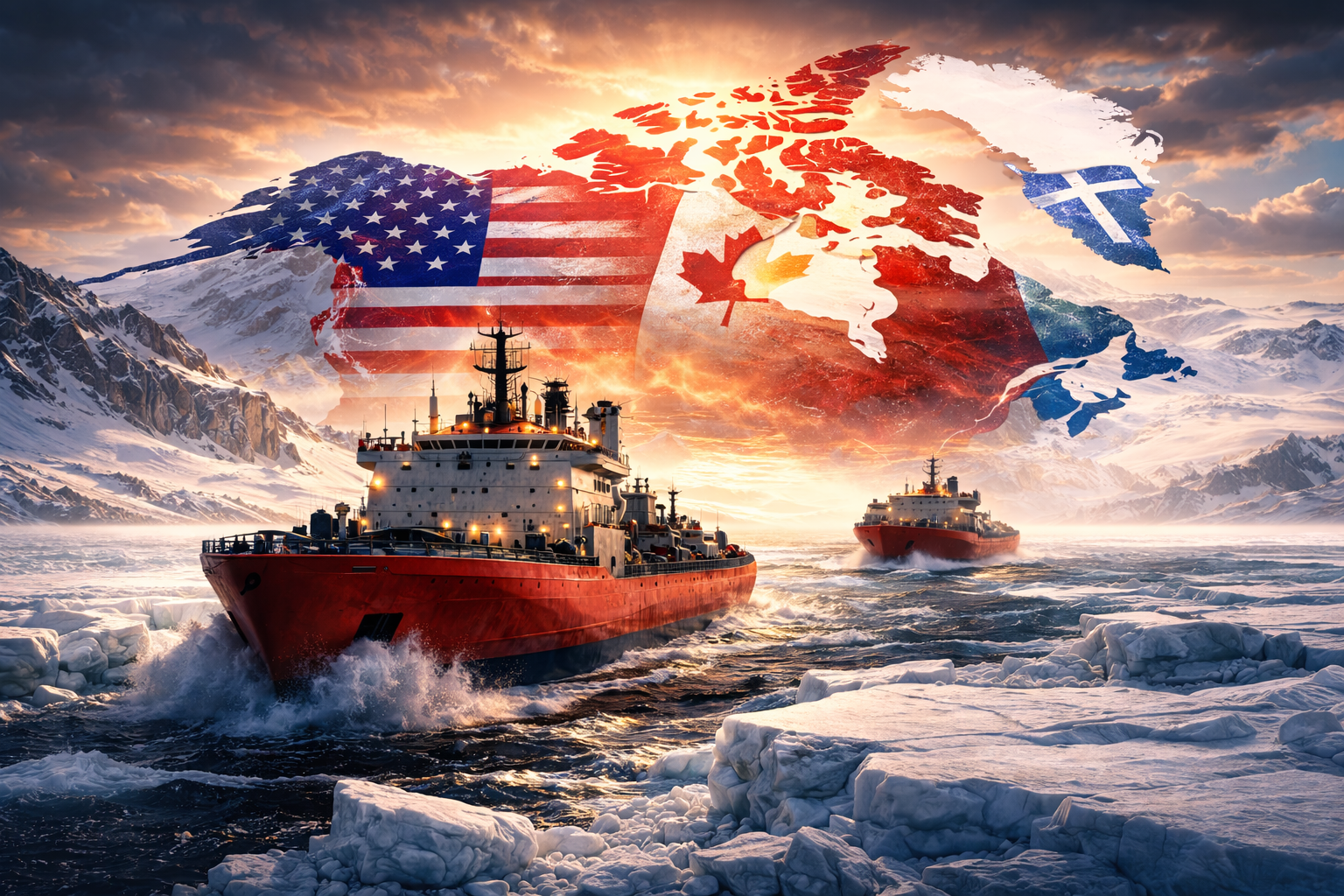
The United States Coast Guard operates three polar icebreakers. Three.
The Polar Star, commissioned in 1976, is the only heavy icebreaker in the fleet. It’s 48 years old. Engineers keep it running by scavenging parts from its long-idled sister ship, the Polar Sea. The Healy, a medium icebreaker launched in 1999, handles most Arctic research and patrol duties – when it’s not in drydock after a major fire in 2020 and a mechanical failure in 2024. The third, the USCGC Storis, was a commercial offshore supply vessel purchased in 2024 and hastily retooled for polar operations. It was the first polar icebreaker the Coast Guard had acquired in 25 years.
Russia operates over 40 polar icebreakers, including seven nuclear-powered ones. China – which is not an Arctic nation – operates four, with a fifth on the way. The United States has three.
The Coast Guard says it needs eight to nine polar icebreakers to meet its mission requirements. It has three. The much-touted Polar Security Cutter program, announced in 2019 with an initial delivery target of 2024, hasn’t delivered a single ship. The first vessel’s delivery has slipped six years to 2030. Costs have ballooned from $1.9 billion to nearly $5 billion. The Congressional Budget Office and CRS have both flagged the program as critically behind schedule.
This isn’t a marginal capability gap. The Arctic is where Russian ballistic missile submarines deploy. It’s where the Northern Sea Route – the ice highway connecting Europe to Asia along Russia’s northern coast – is opening as ice retreats. It’s where China, calling itself a “near-Arctic state,” has been sending research vessels to map the seafloor. Last year, two Chinese research ships cruised through an area of seabed claimed by the United States off Alaska. The Coast Guard scrambled the Healy to observe them.
These provocations will multiply. The Pentagon’s 2024 Arctic Strategy called the Arctic’s maritime chokepoints “strategically significant” and flagged reduced sea ice as making them “more navigable and more economically and militarily significant.” Russia has been redeploying air, naval, missile, radar, and anti-submarine assets to forward Arctic bases. It has launched a new class of combat icebreakers – armed with high-speed guns and launchers for anti-ship and land-attack cruise missiles.
The United States can’t project power in the Arctic because it can’t get there. It has the world’s most powerful navy and an icebreaker fleet smaller than China’s. That’s the gap.
Why the ice matters
The military dimension is obvious. But the commercial stakes may be larger, and they’re what connect the icebreaker problem to the rest of the architecture. I’ll get into the details in a moment – the trade routes opening up, the distance savings, the sovereignty questions. But first, the response.
Because the US didn’t just sit with the problem. It did what it’s been doing across the rest of the hemisphere: it outsourced what it couldn’t build.
The pact
On July 11, 2024, the United States, Canada, and Finland signed what they called the Icebreaker Collaboration Effort – the ICE Pact. The name is too cute by half, but the substance is real.
The logic is simple and it’s the same logic that drives the rest of the architecture I’ve been describing: the US can’t do it alone. American shipyards have fallen from global leadership in 1975 to 19th place today. The UN reports that only 0.13% of the world’s shipbuilding capacity resides in North America. China, by contrast, is responsible for more than half of global commercial shipbuilding output. The US doesn’t have the yards, the workforce, or the experience to build icebreakers at the speed and scale the Arctic requires.
Finland does. Helsinki Shipyard has built more than half of the world’s icebreakers. Finland has designed 80% of them and built 60%. It’s the world’s undisputed icebreaker superpower, operating from a country of 5.5 million people on Russia’s border.
Canada has the second-largest icebreaking fleet in the world – 18 vessels – and two shipyards, Seaspan in British Columbia and Chantier Davie in Quebec, that have been building ice-capable vessels for decades. Canada also has something the US and Finland don’t: the longest Arctic coastline after Russia.
The ICE Pact outsources what America can’t build. In November 2024, the three countries signed a formal Memorandum of Understanding in Washington. In October 2025, the US Coast Guard selected two designs for its Arctic Security Cutter program: one from Seaspan and Finnish firm Aker Arctic, and another from Davie and Helsinki Shipyard. Up to 11 new Arctic Security Cutters will be built using these designs. In October 2025, Trump and Finnish President Alexander Stubb signed a bilateral MoU, and a $6.1 billion deal was announced for Finland to sell up to four icebreakers to the US Coast Guard.
The One Big Beautiful Bill, signed July 4, 2025, appropriated $4.3 billion for the Polar Security Cutter program and $3.5 billion for the Arctic Security Cutters. DHS called it “the largest and most transformative Arctic and maritime investment in US history.”
Canadian shipbuilder Davie announced plans to acquire shipyard assets in Texas – positioning itself to build subsequent vessels domestically after the initial ships are delivered from Canadian and Finnish yards. The technology transfer is built into the partnership: Finland and Canada build the first wave; the US absorbs the expertise and ramps domestic capacity for the rest.
The parallels to the rest of the architecture are unmistakable. The US can’t build icebreakers alone, just as it can’t manufacture cars alone (USMCA), extract oil alone (Exxon in Guyana), or fill its construction labor gap alone (Mexico’s workforce). In every case, the solution is the same: bind allies into a shared system where each partner contributes what the US lacks.
Finland gets a multibillion-dollar industrial boost and deepened NATO ties. Canada gets shipyard contracts and Arctic relevance. The US gets icebreakers it can’t build.
The trade routes
The icebreaker gap matters because of what’s underneath the ice – or increasingly, what’s not underneath it anymore.
The Arctic is melting. That’s an environmental catastrophe but it’s also a geopolitical earthquake, because as the ice retreats, the Arctic Ocean is transforming from an impassable barrier into a viable trade corridor. Whoever controls that corridor controls the future geometry of global commerce.
There are two routes that matter now and a third that may matter later. The Northern Sea Route runs along Russia’s northern coast, from the Barents Sea through the Bering Strait. The Northwest Passage threads through Canada’s Arctic Archipelago, connecting the Atlantic to the Pacific. A third – the Transpolar Sea Route, cutting directly across the North Pole – could become viable later this century as ice continues to retreat.
The distance savings are staggering. Yokohama to Rotterdam via the Suez Canal covers roughly 20,000 kilometers. Via the Northern Sea Route, it’s under 9,000 – a 40% reduction in distance and sailing time. Japan to Europe takes 22 days through Suez and roughly 10 days through the Arctic.
The savings in fuel alone are massive: COSCO reported saving 6,900 tons of fuel and over $9 million across 14 trial voyages in 2021. The Northwest Passage offers similar compression: London to Tokyo drops from roughly 14,670 miles around Africa to under 8,000 miles through the Canadian Arctic. An East Asia to East Coast North America voyage via the Northwest Passage cuts transit time by about 10 days compared to the Panama Canal.
These aren’t theoretical projections. In 2013, the bulk carrier Nordic Orion transited the Northwest Passage from Vancouver to Finland, saving $200,000 and four days over the Panama Canal route. The ship drew too much water to use the Panama Canal at all – the Arctic was its only shortcut. In 2024, the first Panamax containership crossed the Northern Sea Route without an icebreaker escort. In 2025, 103 full transits were completed along the Northern Sea Route by 88 vessels, carrying approximately 3.2 million tons of cargo – up from 2.1 million tons in 2010. The container ship Istanbul Bridge completed its maiden Arctic run to the UK port of Felixstowe in 20 days, versus the 40-50 days typical via Suez or the Cape of Good Hope. Arctic shipping traffic overall has increased 37% over the past decade, with 1,781 unique ships sailing a combined 12.7 million nautical miles in 2024.
It’s still seasonal – the 2025 navigation window ran roughly four and a half months, from late June to mid-November – and it’s still small relative to global shipping. But the physical conditions enabling it are accelerating. The Arctic is warming at roughly four times the global average. Minimum ice extent has shrunk 39% since 1980. The Greenland ice sheet alone lost 129 billion metric tons in 2025. Research published in Nature Communications projects that Arctic route usage will continue to increase, with the Central Arctic Route eventually contributing the majority of trans-Arctic traffic.
And this is where the geopolitics get sharp.
In October 2025, Russia and China signed a comprehensive agreement to jointly develop the Northern Sea Route as the backbone of what Beijing calls the “Polar Silk Road.” Moscow projects annual cargo traffic reaching tens of millions of tons by 2030, driven by LNG exports and containerized trade between East Asia and Europe. Russia controls the route operationally – Rosatom manages it with the world’s only nuclear-powered icebreaker fleet. China provides the financial and manufacturing scale. Together, they are building an integrated Eurasian maritime corridor that bypasses every chokepoint the US Navy currently dominates: Suez, Hormuz, Malacca, Panama. (I’ll go deeper on the Silk Road and its implications in a future post – for now, the point is that the Arctic is a piece of a larger Chinese infrastructure strategy that extends well beyond shipping lanes.)
If Russia and China establish a functioning Arctic trade route that they jointly control, it creates an alternative to the US-dominated maritime order that has underpinned American power since 1945. Ships that sail through the Arctic don’t pass through the Strait of Hormuz. They don’t transit the Suez Canal. They don’t use the Panama Canal. They sail through waters that Russia controls on one side and that the US and Canada are scrambling to control on the other.
The Northwest Passage adds another layer. Canada claims the Passage as internal waters – full Canadian sovereignty, meaning Ottawa can regulate or deny transit. The United States has consistently argued it’s an international strait, subject to transit passage rights for all nations. This legal dispute has been simmering since 1969, when the tanker SS Manhattan sailed through without Canadian permission, and it flared again in 1985 when the Coast Guard icebreaker Polar Sea did the same, sparking a diplomatic crisis. The 1988 Arctic Cooperation Agreement resolved the practical problem without resolving the legal question: the US agreed to seek Canadian consent for icebreaker transits, without conceding the sovereignty claim. As recently as 2005, US nuclear submarines transited unannounced, violating the agreement and sparking outrage in Ottawa.
That ambiguity worked when the passage was frozen shut most of the year. It doesn’t work as ice retreats and the route becomes commercially viable. As Open Canada warned in late 2025: “If the two closest North American allies can’t agree on rules in their melting backyard, others are poised to define them instead.”
The ICE Pact is, among other things, an architecture built around this unresolved question. The US and Canada can’t agree on who owns the Northwest Passage. But they can agree to build icebreakers together. They can agree on “shared stewardship” of Arctic waters. They can agree that Russia and China should not set the rules for Arctic navigation. If the US and Canada are patrolling the passage together, with ships they built together, the question of whether it’s “internal waters” or an “international strait” becomes increasingly academic.
Don’t resolve the dispute. Build the architecture around it.
In practice: if the US and Canada align on treating the Northwest Passage as internal North American waters – which ICE Pact cooperation implicitly supports – then the Western hemisphere controls a trans-Arctic shipping route that competes with Russia’s Northern Sea Route. China can build all the icebreakers it wants, but if the passage through Canada’s archipelago requires North American permission, Beijing’s “near-Arctic state” ambitions hit a wall.
This is why the Canada relationship matters so much more than the trade war headlines suggest. Canada isn’t just a trade partner. It’s the other half of the Arctic gate. An aligned Canada means the Northwest Passage is a jointly managed North American asset. A Canada that’s hedging toward Beijing – Carney calling China “a more predictable partner” – is a Canada that might be willing to internationalize the Passage, letting Chinese shipping through on terms that undermine the whole architecture. The ICE Pact icebreakers, built in Canadian and Finnish yards, are the hardware that makes “Denial of Access” physically possible. Without them, the Northwest Passage is an unpatrolled strait that anyone with an ice-capable ship can transit.
And Greenland sits at the junction of everything. The GIUK Gap on one side, the Northwest Passage approaches on the other, the Northern Sea Route exit points above. Control the approaches to Greenland and you control the gateway between the Arctic shipping lanes and the North Atlantic. That’s the real reason Pituffik Space Base matters beyond missile defense – it’s the northernmost deep-water port in the Western hemisphere, positioned at the chokepoint where the Arctic meets the Atlantic.
The island
Now look at Greenland. Because the icebreaker story and the Greenland story are two sides of the same strategic coin.
Greenland is the world’s largest island – 836,000 square miles – with a population of roughly 56,000. It’s an autonomous territory within the Kingdom of Denmark, with its own parliament and self-governing authority over most domestic affairs. Denmark handles foreign policy and defense, and provides an annual subsidy of approximately $600 million that funds a substantial portion of Greenland’s public services.
The United States has been there since 1941. During World War II, the US established weather stations and airfields across Greenland after Germany occupied Denmark. The 1951 Defense of Greenland Agreement gave the US permanent authority to build and operate military installations on the island. At the Cold War’s peak, roughly 15,000 American personnel were stationed across seventeen installations. Today, only one remains: Pituffik Space Base, formerly Thule Air Base, the northernmost Department of Defense installation on earth – 750 miles north of the Arctic Circle, 947 miles from the North Pole.
Pituffik is not a relic. The 12th Space Warning Squadron operates an Upgraded Early Warning Radar that provides missile detection and space surveillance as part of NORAD. It’s a sensor node in the ballistic missile defense network that protects North America. The base has the world’s northernmost deep-water port, critical for Arctic logistics. In June 2025, the Pentagon shifted geographic responsibility for Greenland from European Command to Northern Command – aligning it with continental defense rather than European theater operations.
And Greenland sits at the center of the GIUK Gap – the maritime passage between Greenland, Iceland, and the United Kingdom that links the Arctic Ocean to the North Atlantic. During the Cold War, this was the chokepoint where NATO tracked Russian submarines heading into the Atlantic. It matters again. Russia’s Northern Fleet must pass through this gap to reach the open ocean. Monitoring it requires presence – and that presence requires ice-capable ships and Arctic infrastructure.
The courtship
Trump’s interest in Greenland has been treated mostly as a punchline. First in 2019, when he proposed buying the island and was rebuffed by Danish Prime Minister Mette Frederiksen, who called it “absurd.” Then again starting in late 2024, when he declared Greenland an “absolute necessity” for national security and refused to rule out military force.
The rhetoric has been genuinely alarming to Greenlanders. Eighty-five percent said they don’t want to become part of the United States, according to a January 2025 poll. Protests drew nearly a third of Nuuk’s population. The base commander at Pituffik was relieved of command in April 2025 after sending an email to personnel that was deemed to be “undermining” Vice President Vance’s visit. European nations, including France and Germany, sent troops to Greenland in a show of solidarity with Denmark.
But underneath the noise, there’s a quieter strategy that looks more like what I’ve described in every other post in this series – not acquisition, but binding.
In 2020, during Trump’s first term, the US reopened its consulate in Nuuk. In 2019, the US signed a Memorandum of Understanding with Greenland to jointly survey and develop rare earth and critical mineral resources. In June 2025, the US Export-Import Bank sent a letter of interest to Critical Metals Corp for a $120 million loan to fund the Tanbreez rare earth mine in southern Greenland – the first overseas mining investment the Trump administration has backed.
Greenland holds an estimated 36-42 million metric tons of rare earth oxides, potentially the world’s second-largest reserve after China. The island is believed to contain 27 of the 34 minerals the EU defines as critical. With China controlling 69% of global rare earth production, alternative sources are a genuine strategic priority. (A future post will go deep on the global mineral map and where Greenland fits in the broader resource competition.)
But the mining reality is sobering. Greenland has essentially no mining infrastructure. Only two mines are currently operational – a gold mine and an anorthosite mine. The climate is brutal. There are no roads between settlements. A 2014 report by 13 scholars concluded that replacing the Danish subsidy through mining would require 24 large projects, each costing 5 billion kroner, one opening every two years – and no investors existed for such a scale. A decade later, that assessment hasn’t materially changed. Anthony Marchese, chairman of Texas Mineral Resources Corporation, told Fortune: “If you’re going to go to Greenland for its minerals, you’re talking billions upon billions of dollars over decades.”
This is where the Greenland strategy starts to look like the Guyana strategy.
Greenland can’t develop its minerals alone. It doesn’t have the capital, the infrastructure, or the workforce. If it ever achieves independence from Denmark – which most Greenlanders support in principle, but only when economically feasible – it will need a new sponsor. A Greenlandic independence report is expected by the end of 2026. RAND published a 2021 study expressing concern that an independent Greenland “could be seduced into Russia’s or China’s orbit.”
The US approach – investment in mining, the consulate in Nuuk, the Export-Import Bank loan, the security cooperation – is designed to make sure that when Greenland looks for economic partnerships to replace the Danish subsidy, Washington is already in the room. Not ownership. Dependency. The same structural relationship the US has with Guyana.
The Greenlandic prime minister, Jens-Frederik Nielsen, said the island is “open for business.” His mining minister told the Washington Post that Greenland is keen for European and American investment – and wary of the Chinese. The door is open. The question is who walks through it.
If you want to know what happened when the administration tried to force the issue in January 2026 – and what it revealed about the gap between strategy and execution – I wrote about it separately in The Greenland Debacle.
The picture from the top
Stand at the top of the architecture and look down.
To the south, an energy supply chain running from Guyana to European refineries, secured by the US Navy. Below that, a trade perimeter defined by USMCA, with Chinese infrastructure systematically removed from ports, telecom networks, and manufacturing bases. Inside that perimeter, Mexico serving as the advanced manufacturing hub, Central America providing tiered labor, and the domestic US economy being restructured through forced automation.
And to the north, the roof. An icebreaker fleet being rebuilt through a trilateral partnership with Finland and Canada. An opening Arctic that is becoming the most strategically valuable real estate on earth – not just for missiles and submarines, but for the trade routes that will reshape global commerce as the ice retreats. A maritime corridor that Russia and China are jointly developing on one side, and that the US and Canada are racing to control on the other. A radar installation on the world’s northernmost military base, watching for missiles over the Arctic. An island rich in rare earths, being slowly bound into the American economic orbit through investment and diplomatic courtship. And a legal question – whether the Northwest Passage is Canadian internal waters or an international strait – that will determine whether the hemisphere’s northern gate stays locked or swings open.
The ICE Pact is the Arctic equivalent of USMCA. It binds allies into a shared production system – icebreakers instead of cars – where each country contributes capabilities the others lack, in exchange for participation in the architecture. Greenland is the Arctic equivalent of Guyana. A small, resource-rich territory that can’t develop alone, positioned at a strategic chokepoint, being offered investment and security guarantees that create dependency.
And the icebreaker gap – three American vessels against Russia’s forty – is the vulnerability that makes the whole northern flank urgent. Without ice-capable ships, the US can’t patrol the Arctic, can’t secure the Northwest Passage, can’t escort commercial traffic through newly opening sea lanes, and can’t respond when Chinese research vessels show up off Alaska to map the seafloor.
The administration’s stated goal is 70-90 Arctic-capable ships built within a decade. That’s not going to happen. But even building toward eight or nine polar icebreakers – the Coast Guard’s assessed minimum – would transform America’s Arctic posture from absence to presence. And with Finnish expertise, Canadian industrial capacity, and $7.8 billion in congressional funding, the pieces are in motion.
I said in the first post that you don’t need a conspiracy to produce a pattern. You just need institutions acting rationally in their own interest, in an environment where those interests converge. Finland joined NATO after Russia invaded Ukraine and needs to demonstrate its value to the alliance. Canada needs Arctic relevance and shipyard employment. The US needs icebreakers it can’t build. Greenland needs investment to fund its eventual independence. Each actor has its own logic.
But the result, again, looks like a system. The roof is going up.
Next: Post 6 – the critical minerals that make the whole architecture possible, from the Lithium Triangle to the Andean copper corridor, and the countries being asked to serve as the hemisphere’s mine.
Sources and data referenced in this post:
- Visual Capitalist, “Mapped: How Arctic Ice Loss Is Reshaping Global Shipping,” February 2026 – Arctic shipping increased 37% over past decade, 1,781 unique ships / 12.7M nautical miles in 2024, first China-Europe NSR transit 2025 in approximately 20 days, Arctic minimum ice extent shrunk 39% since 1980, Greenland ice sheet lost 129B metric tons in 2025, Arctic warming 4x global average (visualcapitalist.com)
- The Geography of Transport Systems, “Polar Shipping Routes” – NSR reduces Europe-East Asia journey from 21,000km (Suez) to 12,800km, cutting 10-15 days; NWP reduces East Asia-East Coast NA from 24,000km (Panama) to 13,600km, cutting approximately 10 days; first Panamax containership crossed NSR without icebreaker escort 2024 (transportgeography.org)
- Arctic Institute, “The Future of the Northern Sea Route” – NSR distance savings up to 50% vs Suez/Panama, Japan-Europe 10 days via Arctic vs 22 via Suez vs 29 via Cape of Good Hope, Yokohama-Rotterdam approximately 9,000km via NSR vs approximately 20,000km via Suez (thearcticinstitute.org)
- Arctic Institute, “A Bridge Across Two Oceans: The Arctic Challenge to Panama Canal Shipping” – Nordic Orion saved $200,000 and 4 days via NWP vs Panama Canal (2013), up to 30% shorter journeys US East Coast-Asia via NWP vs Panama (thearcticinstitute.org)
- Nature Communications, “Arctic Sea Route access reshapes global shipping carbon emissions,” September 2025 – ASR use projected to increase, Central Arctic Route contributing 58.28% of Arctic shipping traffic (nature.com)
- Belfer Center, “The Northwest Passage’s Shipping Potential, Legal Status, and What’s at Stake,” July 2025 – Canada claims NWP as internal waters, US claims international strait under UNCLOS Article 37, legal status unresolved (belfercenter.org)
- Open Canada, “Close the Gap in the North,” December 2025 – US-Canada NWP dispute “becoming dangerous,” “if the two closest North American allies can’t agree on rules in their melting backyard, others are poised to define them instead” (opencanada.org)
- Wikipedia, “Northwest Passage” – 1969 SS Manhattan transit, 1985 Polar Sea incident, 1988 Arctic Cooperation Agreement, Canada 1986 internal waters declaration (wikipedia.org)
- Foreign Policy Research Institute, “America Looks to Finland to Save Its Icebreaker Fleet,” October 2025 – US has three polar icebreakers, Russia 40+, China 4 with 5th on the way, Polar Star commissioned 1976, Coast Guard needs 8-9 icebreakers (fpri.org)
- CSIS, “How the United States Can Overcome Icebreaker Construction Woes and Grow the Maritime Industrial Base,” January 2026 – PSC program delays ($1.9B to $5B+), delivery slipped from 2024 to 2030, One Big Beautiful Bill appropriations ($4.3B PSC, $3.5B ASC) (csis.org)
- Wilson Center, “360 View of America’s ICE Pact,” 2024 – US has “only two aging diesel icebreakers,” China more icebreakers than US, Russia launching combat icebreakers, UN 0.13% of world shipbuilding in North America (wilsoncenter.org)
- US Naval Institute Proceedings, “Close the Icebreaker Gap with ICE Pact,” August 2025 – ICE Pact MOU signed November 13, 2024, Trump/Stubb March 2025 statement, Coast Guard April 2025 RFI (usni.org)
- Canada.ca, “Icebreaker Collaboration Effort” – Canadian Coast Guard 18 icebreakers (second largest fleet globally), October 2025 ASC design selections (Seaspan/Aker Arctic and Davie/Helsinki Shipyard) (canada.ca)
- Finnish Government, “Finland, the United States and Canada confirm support for ICE Pact,” November 18, 2025 – JSOI signing, Helsinki/Washington meetings (valtioneuvosto.fi)
- Fox News, “US turns to Finland to close Arctic ‘icebreaker gap,’” October 2025 – $6.1 billion deal for up to four icebreakers, Storis 112-day Arctic patrol monitoring Chinese vessels (foxnews.com)
- DHS, “ICE Pact” official page – “largest and most transformative Arctic and maritime investment in US history” (dhs.gov)
- Breaking Defense, “After Trump’s promise of 40 ‘big’ icebreakers, Coast Guard says eight or nine will do,” April 2025 – realistic assessment of needs (breakingdefense.com)
- Polar Journal, “The Complex Path to a New U.S. Icebreaker Fleet,” July 2025 – PSC delivery slipped to 2030, Davie acquiring Texas shipyard (polarjournal.net)
- Wikipedia, “ICE Pact” – US goal of 70-90 Arctic-capable ships in a decade, Helsinki Shipyard built 60% of world’s icebreakers (wikipedia.org)
- Statista/IISS – Russia 57 icebreakers and ice-capable patrol ships (2022), NATO combined 47 (statista.com)
- Pentagon 2024 Arctic Strategy – Arctic chokepoints “strategically significant,” reduced sea ice making them “more navigable and more economically and militarily significant” (cited via FPRI)
- CSIS, “Greenland, Rare Earths, and Arctic Security,” January 2026 – 36-42 million metric tons REE reserves, second-largest after China, China 69% of global production, US Ex-Im Bank $120M letter of interest for Tanbreez mine (csis.org)
- Fortune, “Trump’s Greenland mining plan would cost ‘billions upon billions,’” January 2026 – Anthony Marchese quote, only one fully operational mine, Denmark $600M annual subsidy (fortune.com)
- Washington Post, “Trump covets rare earth minerals, but Greenland’s riches will be hard to mine,” July 2025 – PM Jens-Frederik Nielsen “open for business,” mining minister wary of Chinese (washingtonpost.com)
- CNN, “Trump’s Greenland mining dreams collide with reality,” January 2026 – 85% of Greenlanders oppose US takeover (January 2025 poll) (cnn.com)
- Wikipedia, “Proposed United States acquisition of Greenland” – 2014 report on 24 projects needed, 2020 consulate reopening, RAND 2021 study on independent Greenland vulnerability (wikipedia.org)
- WITA, “The Polar Silk Road That Could Sideline the West,” October 2025 – Russia-China October 2025 agreement to jointly develop NSR, COSCO 14 trial voyages saved 6,900 tons fuel / $9M+ (wita.org)
- Ship Universe, “Northern Sea Route 2025: More Voyages, Same Hard Limits” – 103 full transits by 88 vessels, 3.2 million tons cargo, Istanbul Bridge maiden run 20 days vs 40-50 days via Suez/Cape (shipuniverse.com)
- NPR, “What to know about Pituffik, the only U.S. military base in Greenland,” March 2025 – Pituffik location, 150 US service members (npr.org)
- Wikipedia, “Pituffik Space Base” – renamed 2023, 12th Space Warning Squadron UEWR operations, Vance March 2025 visit (wikipedia.org)
- SOF News, “Strategic Importance of Greenland,” January 2026 – GIUK Gap renewed strategic importance (sof.news)
- Belfer Center, “Explainer: The Geopolitical Significance of Greenland,” January 2025 – missile early warning, GIUK Gap, Northwest Passage and Transpolar Sea Route positioning (belfercenter.org)
This is Part 5 of the Fortress Hemisphere series. Part 1: Follow the Pipes covers the Guyana energy story. Part 2: The Squeeze covers the systematic removal of Chinese infrastructure. Part 3: The Factory Next Door covers Mexico as the hemispheric manufacturing hub. Part 4: The Trillion-Dollar Tell covers the automation bet and the labor gap.