Series Summary
This is Part 1 of the Fortress Hemisphere series – an examination of how energy, trade, and security architecture are converging to reshape the Western Hemisphere.
- Part 1: Follow the Pipes (this post) – The Guyana oil boom and hemispheric energy strategy
- Part 2: The Squeeze – How Chinese capital is being removed from every chokepoint
- Part 3: The Factory Next Door – How $840 billion in annual trade is binding Mexico into America’s industrial architecture
- Part 4: The Trillion-Dollar Tell – The automation bet, the labor gap, and a $650 billion wager on what comes next
- Part 5: The Roof – Icebreakers, Arctic trade routes, and the top of the architecture
Key Takeaways
- Guyana is pumping 900,000 barrels/day with a GDP growth of 43.6% in 2024 – the fastest of any nation on earth – driven entirely by ExxonMobil’s offshore Stabroek Block
- The production sharing agreement is extraordinarily favorable to the consortium: 75% cost recovery, 2% royalty, zero corporate tax, and a stability clause preventing renegotiation
- The US provides the security architecture that makes the oil flow – including an explicit warning from the Secretary of State to Venezuela
- 66% of Guyana’s crude goes to Europe, not the US – converting energy production into geopolitical leverage even when the barrels don’t land in American ports
- China’s CNOOC owns 25% of the most strategically significant energy asset in the hemisphere, inside an American security perimeter
There’s a country in South America with fewer people than Austin, Texas. It has no army to speak of. Its capital city doesn’t have a traffic light system that works half the time. Ten years ago, its biggest exports were sugar and gold.
Today, it’s pumping 900,000 barrels of oil per day. Its GDP grew 43.6% in 2024 – the fastest of any nation on earth. Its per capita GDP on a purchasing power basis has hit $94,260, vaulting past every country in South America. The IMF says it averaged 47% annual growth over the past three years.
The country is Guyana. And the story of how it got here tells you more about where American power is actually headed than anything you’ll read in the news about tariffs or TikTok bans.
In 2015, ExxonMobil drilled a wildcat well called Liza-1 in Guyana’s offshore Stabroek Block, about 190 kilometers off the coast of Georgetown. They hit 290 feet of oil-bearing reservoir. That single strike kicked off what is now one of the most significant hydrocarbon discoveries of the 21st century.
The Stabroek Block has yielded over 50 discoveries and an estimated 11 billion barrels of recoverable oil. To put that in context – that’s more than the US Geological Survey estimated for the entire Guyana-Suriname Basin back in 2012. The USGS got the number almost exactly wrong: Exxon found more oil in one block than the government scientists thought existed in the whole region.
From first discovery to first oil took just four years. In an industry where major offshore fields routinely take a decade or more to develop, Exxon went from Liza-1 in 2015 to producing crude in December 2019. By August 2025, they had four floating production vessels (FPSOs) operating simultaneously: the Liza Destiny, Liza Unity, Prosperity, and the newly online ONE GUYANA. Each one a massive ship anchored over the seafloor, pumping and storing crude before tankers haul it away.
A country that wasn’t producing oil at all in 2018 is on track to pump 1.7 million barrels per day by the end of the decade. The consortium has committed over $60 billion in development capital.
The fourth vessel, Yellowtail, came online four months ahead of schedule. By November 2025, the combined output hit 900,000 barrels per day. That made Guyana – a country of about 800,000 people – South America’s third-largest oil producer, behind only Brazil and Venezuela. It had quietly overtaken Ecuador, Colombia, and Argentina.
And they’re not done. A fifth project, Uaru, is under construction and expected to begin production in 2026, adding another 250,000 barrels per day. A sixth, Whiptail, follows in 2027. A seventh, Hammerhead, is sanctioned for 2029. An eighth project, Longtail, is in regulatory review. ExxonMobil projects total capacity will reach 1.7 million barrels per day by 2030.
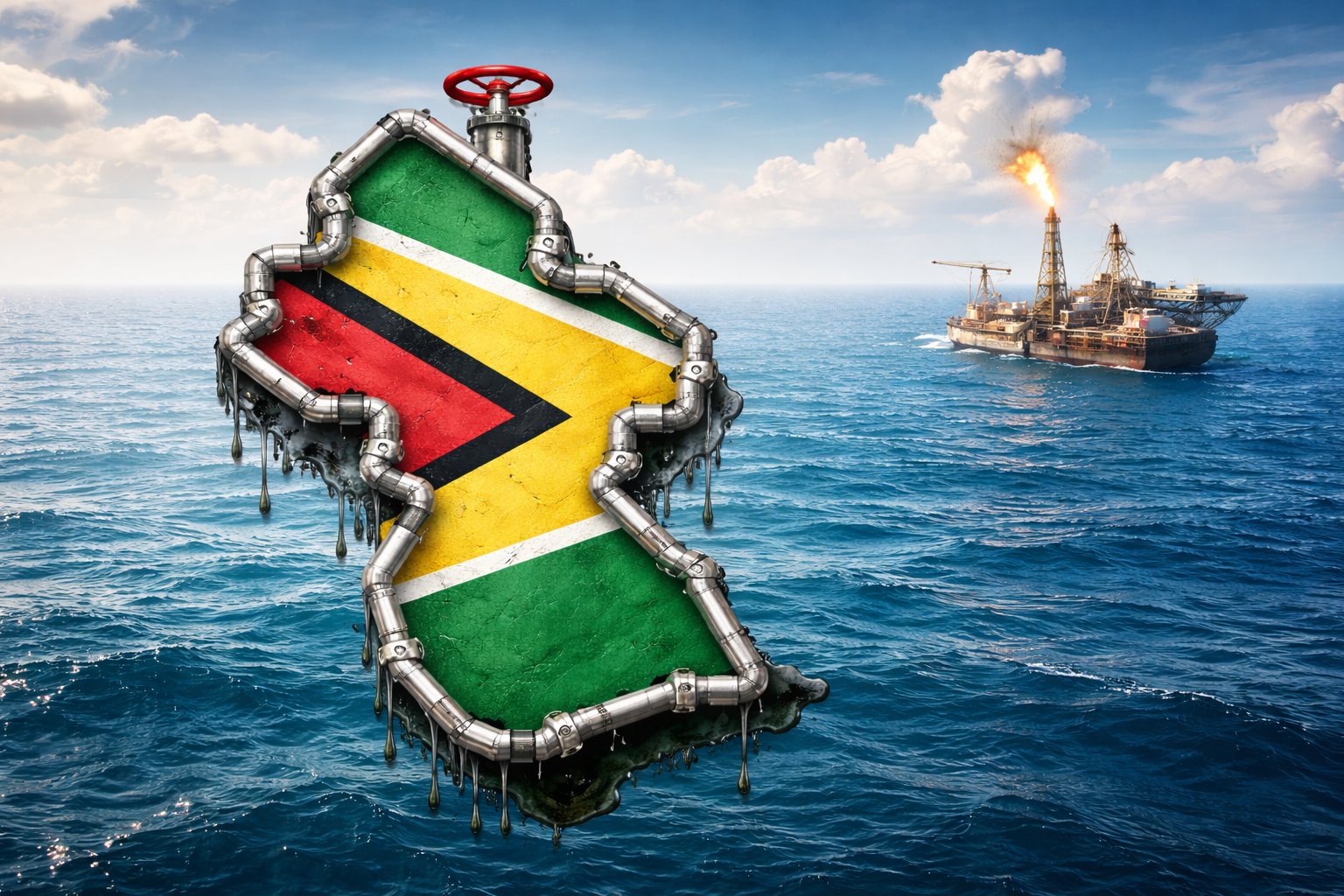
The oil itself is unusually attractive. Golden Arrowhead crude – named after Guyana’s national flag – has an API gravity of 36.5 degrees and sulfur content of just 0.25%. It’s light and sweet, exactly the kind of crude the market increasingly prefers. Its emission intensity is roughly 9 kilograms of carbon per barrel, about half the global upstream average. And crucially, the breakeven cost is around $30 per barrel, making these fields profitable even in a sustained price downturn.
These are all public numbers. They’re in ExxonMobil’s quarterly filings, in EIA reports, in IMF country assessments. Nothing speculative about them.
Here’s where it gets interesting.
Who’s at the table
The Stabroek Block consortium has three partners. ExxonMobil is the operator with a 45% stake. Hess Guyana Exploration holds 30% – a position that transferred to Chevron in practice after Chevron completed its acquisition of Hess Corporation, winning a contentious arbitration battle that went to the International Chamber of Commerce in July 2025. The third partner, holding 25%, is CNOOC Petroleum Guyana Limited – a subsidiary of the China National Offshore Oil Corporation.
A quarter of the most productive new oil field in the Western Hemisphere is owned by a Chinese state-backed company. This is not a recent development. CNOOC has been a partner in the Stabroek Block since before the first discovery.
Keep that in your pocket. We’ll come back to it.
The terms of the deal
The production sharing agreement (PSA) that governs the Stabroek Block was signed in 2016, back when Guyana had zero oil production and enormous geological risk. The terms are, to put it diplomatically, extremely favorable to the consortium.
Under the deal, ExxonMobil can recover up to 75% of monthly revenue as “cost oil” – reimbursement for its exploration and development investments. The remaining 25% is “profit oil,” split 50/50 between the consortium and the government. On top of that, Guyana receives a 2% royalty on all petroleum produced and sold. The consortium pays zero corporate tax. There is a stability clause – Article 32 – that prevents Guyana from unilaterally renegotiating the contract without ExxonMobil’s written consent.
These terms have been roundly criticized. The BBC challenged ExxonMobil’s Guyana president Alistair Routledge on air, noting that the standard royalty rate in comparable jurisdictions is closer to 10%. Guyana’s own Vice President Bharrat Jagdeo has publicly described the arrangement as “lopsided.” A Guyanese economics professor at Howard University, Dr. Kenrick Hunte, has argued that the effective royalty Guyana actually receives is closer to 0.5% due to how cost recovery interacts with the royalty calculation. By the end of 2023, ExxonMobil had recovered approximately $19 billion of the $29 billion it reported spending in Guyana.
President Irfaan Ali has acknowledged the deal is poor but refuses to renegotiate, citing the sanctity of contracts and the need to maintain investor confidence. Guyana has drafted a new model PSA with a minimum 10% royalty – but it will only apply to future blocks, not the Stabroek Block where all the oil actually is.
So here’s the picture: the world’s most productive new oil basin, developed at breakneck speed, under terms that are extraordinarily advantageous for the US-headquartered operator. And Guyana accepts this because the alternative – scaring away the only companies capable of extracting the oil – is worse.
The security umbrella
On March 27, 2025, US Secretary of State Marco Rubio flew to Georgetown. It was his second trip to Latin America and the Caribbean in just two months as Secretary of State – a notable signal about where the administration’s attention was focused. During a joint press conference with President Ali, Rubio said something striking:
“It will be a very bad day for the Venezuelan regime if they were to attack Guyana or attack ExxonMobil, and it would not end well for them.”
That is the US Secretary of State explicitly promising military consequences for any threat to ExxonMobil’s oil operations. The statement was described by Guyana’s former ambassador to the United States, Riyad Insanally, as the strongest public commitment from a senior US official in support of Guyana to date.
The two countries signed a Memorandum of Understanding on security cooperation covering information sharing, synthetic drug detection, transnational crime, and military-to-military coordination. The US Southern Command has been steadily upgrading Guyana’s defense capabilities – building coast guard stations, supplying patrol boats, constructing new hangars, developing radio networks, and establishing a Jungle Amphibious Training School.
Guyana’s defense budget jumped 85% in a single year. It’s not hard to see why. Venezuela has been aggressively pressing its long-dormant claim to the Essequibo region – which constitutes roughly two-thirds of Guyana’s land territory and, not coincidentally, lies adjacent to the offshore oil fields.
The Venezuelan escalation has been genuinely alarming. In December 2023, Maduro held a national referendum on annexing the Essequibo and signed the result into law in April 2024, formally establishing “Guayana Esequiba” as a Venezuelan state – a designation that exists only in Caracas. In March 2025, a Venezuelan navy warship approached ExxonMobil’s FPSO vessels in waters off Georgetown – not the disputed border region, but Guyana’s undisputed exclusive economic zone – and informed the crews they were in Venezuelan territory. Six Guyanese soldiers were shot and injured at the border in February 2025 by what Georgetown described as Venezuelan gang members.
The US response has been unambiguous. Joint military exercises. Naval presence. CIA director William Burns visited Guyana in March 2024. Rubio’s visit with the explicit warning. The security cooperation agreement. The steady armament of the Guyanese coast guard and defense force.
Maduro wasn’t wrong about one thing, however uncomfortable the framing. In a 2024 address, he accused ExxonMobil, the Southern Command, and the CIA of jointly governing Guyana. That’s crude agitprop, but it touches on something real: the United States is providing the security architecture that allows the oil to flow. This isn’t hidden. It’s in the State Department press releases.
The Venezuela side of the equation
Now zoom out. Because Guyana doesn’t exist in isolation – it sits next door to a country with the largest proven oil reserves on the planet, and the relationship between those two facts is not accidental.
Venezuela’s Orinoco Belt contains an estimated 300 billion barrels of proven reserves. But Venezuela’s production has collapsed from over 3 million barrels per day in the late 1990s to roughly 900,000 bpd – crippled by two decades of PDVSA mismanagement, the nationalization of foreign assets, capital flight, and punishing US sanctions. The economy contracted by an estimated 80% under the Maduro government. Nearly 8 million Venezuelans have fled the country – a displacement crisis larger than Syria’s.
For US Gulf Coast refineries, Venezuela’s heavy sour crude is not interchangeable with light sweet oil from the Permian Basin or Guyana. Refineries in Pascagoula, Mississippi, and Pasadena, Texas, were specifically configured decades ago to process heavy, sulfur-rich crudes. When Venezuelan supply was cut off, they had to scramble for alternatives from Canada, Mexico, and offshore US sources – all more expensive or logistically constrained.
The Biden administration tried a carrot approach. In November 2022, OFAC issued General License 41, allowing Chevron to resume production and export from its joint ventures with PDVSA. The idea was to incentivize democratic reforms – specifically, free and fair elections – in exchange for sanctions relief and access to US markets. Chevron was producing roughly 220,000 barrels per day under this arrangement, and the heavy crude went straight to the Gulf Coast refineries that needed it.
Then Venezuela held its July 2024 presidential election, and the Carter Center’s observation mission reported that opposition candidate Edmundo González had won. Maduro claimed victory anyway, intensified domestic repression, and cracked down on dissent. The carrot had failed.
In February 2025, the Trump administration revoked Chevron’s license and ordered a wind-down of operations. By March, OFAC had amended the terms, giving Chevron until late May to cease activities. The administration shifted to maximum pressure – designating Venezuelan criminal organizations as Foreign Terrorist Organizations, deploying naval assets to the Caribbean, and eventually conducting strikes on drug-trafficking vessels linked to Venezuelan networks.
The United States simultaneously cut off one source of hemispheric oil (Venezuelan heavy crude through Chevron) while ramping up another (Guyanese light sweet crude through Exxon). Two neighboring countries, two different types of crude oil, two completely different relationships with Washington – and both feeding into the same system.
By January 2026, US military operations in the Caribbean had escalated to the point of direct action against Venezuelan targets. Operation Southern Spear involved the seizure of oil tankers, a naval quarantine on sanctioned vessels, and ultimately strikes on Venezuelan military infrastructure.
Where the oil actually goes
Here’s something that complicates the simple “America is grabbing the oil” narrative – and makes the picture more interesting.
Most of Guyana’s crude doesn’t go to the United States. It goes to Europe.
In 2024, according to LSEG shipping data reported by Reuters, 66% of Guyana’s crude exports went to European refiners – up from 62% the previous year. In January 2025, the European share hit 75%, with fifteen out of twenty cargoes heading across the Atlantic. The single largest individual buyer of Guyanese crude in Europe is ExxonMobil’s own Fawley refinery in the United Kingdom.
This makes sense when you understand the crude quality mismatch. Guyana produces light sweet crude. European refineries, which are generally less complex than the massive cracking and coking operations on the US Gulf Coast, are the natural market for this grade. US Gulf Coast refineries, by contrast, were specifically configured to process heavy sour crude – the kind that comes from Venezuela, Canada, and Mexico. As one trader of Latin American grades told Reuters, “Europe is the ideal market for Guyana’s crudes.”
The US doesn’t need Guyana’s light sweet crude for its own refineries. What it gets is something arguably more valuable: leverage. Europe becomes partially dependent on a supply chain that the United States secures and US companies control.
European demand for Guyanese oil accelerated sharply after Russia’s invasion of Ukraine in 2022, when refiners scrambled to replace sanctioned Russian crude. Then Red Sea attacks in 2024 disrupted Middle Eastern flows, and Guyana’s proximity and quality gave it another edge.
So the picture isn’t “America takes the oil for itself.” It’s more layered than that. The US controls the production architecture – Exxon operates, Chevron is now a partner, the security umbrella is American – and the oil flows primarily to US allies in Europe. That’s not energy independence in the traditional sense. It’s energy architecture – the ability to shape who gets what, and under what conditions.
The real Venezuela play
This is the part most coverage gets wrong. The dominant narrative around Operation Southern Spear was that it was a resource grab – the US wanted Venezuela’s 300 billion barrels of proven reserves. And yes, Trump himself didn’t dispute that oil was part of the calculus.
But look at what the US actually had when it moved on Venezuela. It already had 900,000 barrels per day flowing from Guyana, ramping to 1.7 million by decade’s end. Chevron’s license – the one that provided access to Venezuelan heavy crude – had already been revoked months earlier. The Gulf Coast refineries were adjusting. The US wasn’t moving on Venezuela because it was running out of oil. It was moving on Venezuela because Maduro was a security liability.
A hostile, unstable Venezuela was threatening Guyana’s oil operations with warships. It was a transit corridor for narcotics and a base for transnational criminal organizations that the administration had designated as terrorist groups. It was a Chinese and Russian partner with $50 billion in outstanding debt to Beijing.
Removing Maduro didn’t primarily unlock Venezuelan barrels for US refiners. What it did was eliminate the security threat to Guyana, open the possibility of resuming exploration in the 30% of the Stabroek Block that had been frozen due to the border dispute, and fundamentally redraw the geopolitical map of northern South America.
Exxon CEO Darren Woods said it plainly: with Maduro gone, “perhaps we’ll see an opportunity with less naval patrols that’ll make it a little more friendly environment.” The Center for Strategic and International Studies assessed that “if there’s any country that reaps the greatest benefit from Maduro’s removal, I would say it’s probably Guyana.”
The China seat at the table
There’s one more thread to pull before we zoom out, and it’s sitting right there in the consortium structure.
CNOOC – China National Offshore Oil Corporation – holds 25% of the Stabroek Block. It’s been there since 2013, when it acquired Canadian company Nexen in a $15.1 billion deal. The Guyana stake wasn’t even the headline of that acquisition – it was practically an afterthought, a minor asset in a portfolio of Canadian oil sands and offshore positions. Nobody knew what the Stabroek Block would become.
Now it’s arguably the most valuable energy concession on the planet, and a Chinese state-backed company owns a quarter of it. CNOOC described the Stabroek Block as one of the “global exploration hotspots” in its 2024 annual report and identified Guyana as a primary source of future production growth.
This creates an awkward reality. The US is providing the security guarantee. US companies operate the block and hold 75% of the equity. The Secretary of State is flying to Georgetown to warn off Venezuela. The Southern Command is building coast guard stations. And 25% of the output belongs to Beijing.
During the Chevron-Hess acquisition fight, CNOOC filed its own arbitration claim asserting a right of first refusal over Hess’s 30% stake. If CNOOC had prevailed, a Chinese state company could have ended up controlling 55% of the Stabroek Block. The ICC ruled in Chevron’s favor in July 2025, but the episode revealed the tension that exists when a strategic competitor has an ownership stake in your most important new energy asset.
The question of whether CNOOC’s 25% stays, shrinks, or gets restructured over time will tell you a great deal about where this is heading. And it connects to a much larger question about who controls the infrastructure that moves oil and goods through the hemisphere.
What this actually looks like
If you step back from any single headline and look at the structural picture, a pattern emerges that’s worth describing plainly.
The United States has, over the span of roughly a decade, done the following in this one corner of South America:
Secured access to the hemisphere’s fastest-growing oil basin through its two largest energy companies, under contract terms that guarantee the vast majority of production flows to or through US-controlled entities.
Established a de facto security guarantee for the country that hosts those operations, including military infrastructure upgrades, direct warnings to the neighboring claimant, intelligence cooperation, and naval presence.
Removed the hostile government next door – not primarily for its oil, but to eliminate the security threat to the oil infrastructure next door and to reshape the strategic map of the entire northern flank of South America.
Created a supply chain where European allies become dependent on oil that US companies produce and the US military protects – converting energy production into geopolitical leverage even when the barrels don’t land in American ports.
None of these things required a smoke-filled room. ExxonMobil was going to develop Guyana’s oil because it’s enormously profitable at $30 breakeven. The Southern Command was going to respond to Venezuelan aggression because that’s what the Southern Command does. The State Department was going to revoke Chevron’s license because Maduro stole an election and the domestic politics demanded it. Each actor pursued its own institutional logic.
But the result is a system. The oil flows. The security architecture protects the oil. The sanctions on Venezuela increase the strategic importance of the oil. The country producing the oil becomes progressively more dependent on the country guaranteeing its security. And the allies who buy the oil become stakeholders in the arrangement’s continuation.
The question this raises
I’m not arguing there’s a master plan. The US government is not organized enough for that kind of coherent long-range strategy. What I’m pointing out is that the observable facts form a pattern – and you don’t need a conspiracy to produce it. You just need a handful of powerful institutions each acting rationally in their own interest, in an environment where those interests converge.
Biologists have a term for this: convergent evolution. Wings evolved separately in birds, bats, and insects – not through coordination, but because flight solves the same problem for all of them.
The defense establishment wants energy supply chains it can protect within the hemisphere. Wall Street wants high-return upstream assets with rule of law. The oil majors want massive, low-cost reserves without Middle East political risk. The State Department wants leverage and a counterweight to Chinese influence.
None of these actors need to be in a room together. They just need to keep doing what they’re already doing. And when you lay their individual actions on a map, you get something that looks remarkably like a strategy.
Guyana is the clearest example – but it’s not the only one. In the next post, I’ll follow this same approach into the systematic removal of Chinese capital from the hemisphere’s chokepoints – and what a port seizure in Panama, a trade clause in USMCA, and a 5G ban in Costa Rica all have in common.
Sources and data referenced in this post:
- ExxonMobil Guyana production milestone announcement, November 13, 2025
- EIA Short-Term Energy Outlook, December 2025 – Brazil, Guyana, Argentina production forecasts
- IMF Article IV Consultation with Guyana, May 2025 – GDP growth averaging 47% annually since 2022
- US State Department 2025 Investment Climate Statement: Guyana – 43.6% GDP growth in 2024
- IMF data: Guyana GDP per capita (PPP) at Int$94,260 in 2025
- OilPrice.com, “Guyana’s Record-Breaking Oil Boom,” November 2025
- CNN, “A tiny rainforest country is growing into a petrostate,” March 2025
- Guyana Department of Public Information, “Playing with fire: The hidden cost of unilaterally renegotiating the 2016 PSA,” July 2025
- BBC HARDtalk interview with Alistair Routledge, February 2024
- US State Department transcript, Secretary Rubio and President Ali Joint Press Availability, March 27, 2025
- Heritage Foundation, “Venezuela’s Aggression Toward Guyana Must End,” 2025
- CSIS, “What Is the Significance of Venezuela’s Naval Incursion into Guyana?” November 2025
- Reuters/LSEG shipping data via U.S. News, January 2025 – Guyana export destinations
- Council on Foreign Relations, “How Guyana’s Oil Boom Will Reshape Energy Security,” February 2026
- California Wall Street, “Guyana oil growth potential rises as tensions ease,” February 2026 – Exxon CEO Woods quote
- Kaieteur News, “Guyana to remain CNOOC’s main source of production growth,” April 2025
This is Part 1 of the Fortress Hemisphere series. Part 2: The Squeeze covers the systematic removal of Chinese infrastructure from the hemisphere. Part 3: The Factory Next Door examines how $840B in annual trade is binding Mexico into America’s industrial architecture. Part 4: The Trillion-Dollar Tell covers the automation bet and the labor gap. Part 5: The Roof covers the Arctic, icebreakers, and the top of the architecture.